Beyond \"Fine\": How the Wheel of Emotions Helps You Decode Your Internal World
We have all been there - sitting across from a friend or a therapist, or perhaps just staring at a blank journal page, trying to answer the deceptively simple question: "How do you feel?" More often than not, our minds default to a handful of generic labels. We feel "good", "bad", "stressed", or simply "fine". But these words are often masks for a much more complex internal reality. They are the low - resolution version of a high - definition experience.
Developing emotional literacy is not just about expanding your vocabulary; it is about survival and connection. When we cannot name what we are feeling, we cannot regulate it. We become reactive instead of responsive. This is where the wheel of emotions becomes one of the most powerful tools in the psychological toolkit. By providing a visual and conceptual map of the human heart, it allows us to zoom in on the specific nuances of our experience, turning a blurry emotional fog into a clear, actionable landscape.
What is the Wheel of Emotions?
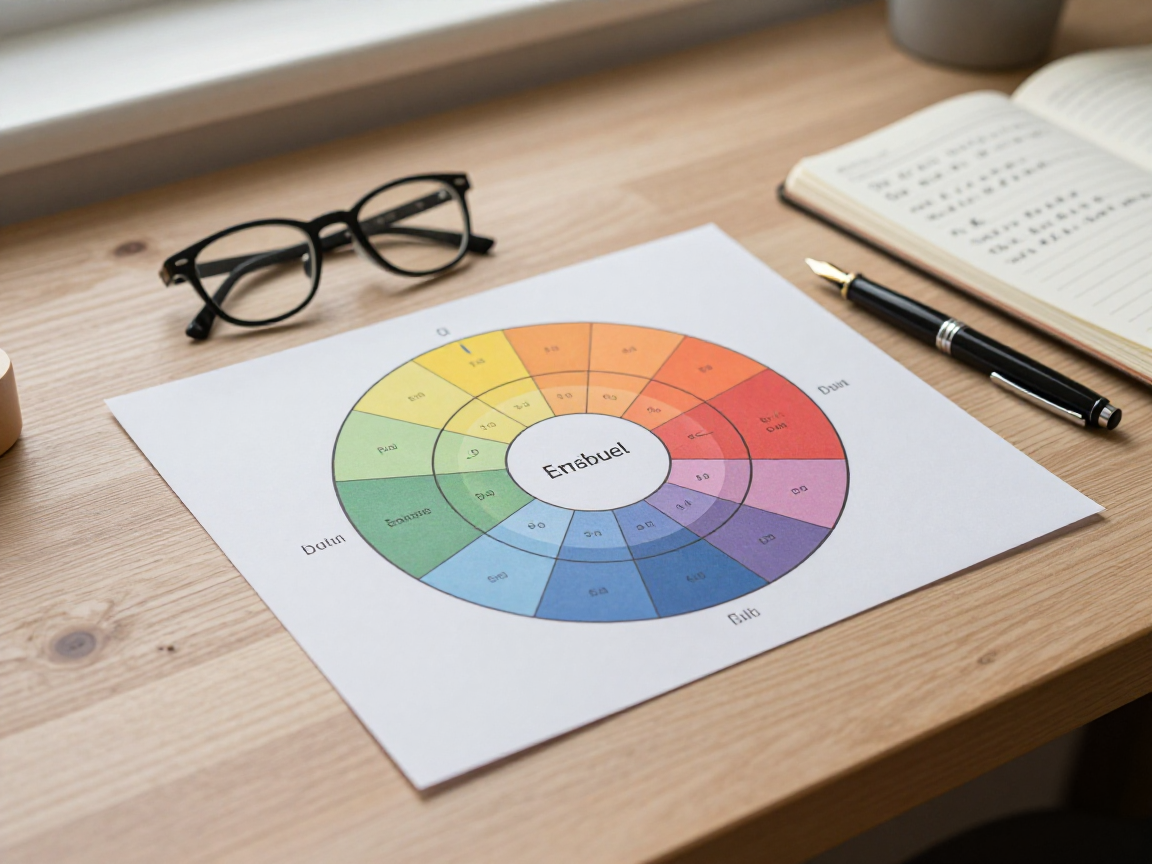
The most famous iteration of this concept was developed by psychologist Robert Plutchik in 1980. Plutchik proposed that humans experience eight primary emotions that serve as the foundation for all other complex feelings. He arranged these on a wheel, much like a color wheel, to show how emotions relate to one another, how they blend, and how they vary in intensity.
Plutchik's wheel of emotions is shaped like a flower with eight petals. Each petal represents a primary emotion, and the positioning is intentional. Opposite emotions are placed across from one another. For example, Joy is the opposite of Sadness, and Anger is the opposite of Fear. This layout helps us understand the duality of our internal states and why certain emotions seem to cancel each other out or exist in tension.
Beyond just listing names, the wheel of emotions uses color and verticality to illustrate the "volume" of a feeling. The center of the wheel features the most intense versions of an emotion (like Rage or Loathing), while the outer edges represent the mildest versions (like Annoyance or Boredom). This distinction is vital because it teaches us that emotions are not binary; they exist on a spectrum of physiological arousal and psychological impact.
The Eight Primary Petals of Human Experience
To use the wheel of emotions effectively, we must first understand the eight core pillars that Plutchik identified. These are not just random labels; Plutchik believed these emotions evolved to help us survive. Each one triggers a specific behavior designed to keep us safe or help us thrive.
1. Joy and Sadness
Joy sits at the top of the wheel. In its mildest form, it is Serenity; at its peak, it is Ecstasy. Its opposite is Sadness, which ranges from Pensiveness to Grief. While Joy encourages us to connect and repeat rewarding behaviors, Sadness signals a loss and a need for social support or reflection.
2. Anger and Fear
Anger (ranging from Annoyance to Rage) is often a protective response to a perceived threat or injustice. Across the wheel lies Fear (ranging from Apprehension to Terror). While Anger moves us toward a threat to fight it, Fear moves us away from a threat to find safety.
3. Trust and Disgust
Trust is the foundation of social bonding, moving from Acceptance to Admiration. Its opposite is Disgust, which moves from Boredom to Loathing. Evolutionarily, Disgust kept us away from poisonous food or disease, while Trust allowed us to build tribes.
4. Anticipation and Surprise
Anticipation is the feeling of looking forward, ranging from Interest to Vigilance. Its polar opposite is Surprise, which ranges from Distraction to Amazement. Anticipation is about preparation, while Surprise is the sudden realization that our environment has changed unexpectedly.
The Anatomy of Mixed Emotions
One of the most fascinating aspects of the wheel of emotions is the concept of "dyads". Just as mixing red and blue paint creates purple, mixing two primary emotions creates a complex secondary emotion. We rarely feel just one thing at a time. Humans are masters of the emotional cocktail, and the wheel helps us deconstruct the ingredients.
For instance, when you combine Joy and Trust, you get Love. When you combine Anger and Anticipation, you get Aggressiveness. When you combine Surprise and Sadness, you get Disappointment. Understanding these combinations is a breakthrough for many people who feel "confused" by their reactions. You might realize that your feeling of Guilt is actually a mix of Joy and Fear, or that your sense of Awe is a combination of Surprise and Trust.
This layering explains why our reactions can sometimes feel contradictory. You can feel the Anticipation of a new job alongside the Fear of failure. By using the wheel of emotions, you can separate these strands, acknowledging the excitement while tending to the anxiety.
A Practical Framework: The 4 - Step Emotional Audit
Knowing the theory is one thing; applying it during a heated argument or a late - night bout of anxiety is another. To turn the wheel of emotions into a functional tool, you can use the following framework whenever you feel overwhelmed.
Step 1: Identify the Core Color
When you feel a "cloud" of emotion, stop and ask which primary petal it most closely resembles. Does this feel like a version of Anger, Sadness, or perhaps Fear? Don't worry about being perfect; just pick a general direction on the wheel.
Step 2: Determine the Intensity
Look at the vertical axis of that petal. On a scale of 1 to 10, how "loud" is this feeling? Is your Anger just a mild Annoyance (a 2), or is it bordering on Rage (a 9)? Recognizing the intensity helps you determine the appropriate response. You don't need the same coping mechanism for Annoyance that you do for Rage.
Step 3: Look for the "Hidden" Ingredient
Check the neighboring petals. Is there a secondary emotion mixed in? For example, you might realize you are feeling Anger, but there is a significant amount of Sadness right next to it. This often reveals the "Why" behind your feeling. We often use Anger as a shield for the vulnerability of Sadness.
Step 4: Name the Evolutionary Need
Ask yourself: "What is this emotion trying to do for me?" If it is Fear, it is trying to protect you. If it is Disgust, it is trying to keep you away from something toxic. When you understand the "job" the emotion is trying to perform, it becomes less of an enemy and more of an internal advisor.
Why We Struggle to Use the Wheel
Even with a map, navigation can be difficult. Many of us were raised in environments where certain parts of the wheel of emotions were off - limits. Perhaps Anger was considered "bad", or Sadness was seen as "weak". When we suppress certain petals of the wheel, they don't go away; they just become distorted.
Suppressing Anger often leads to passive - aggression or physical tension. Suppressing Sadness can lead to a numb, persistent state of Boredom or Disgust. The goal of using the wheel of emotions is not to "fix" our feelings so we only feel the "positive" ones. The goal is total integration. Every emotion on the wheel has a valid place in the human experience. Learning to sit with Disgust or Fear without immediately trying to push it away is the hallmark of true emotional maturity.
The Benefits of Emotional Precision
Why go to all this trouble? The benefits of using the wheel of emotions extend into every corner of your life - from your physical health to your professional success.
- Better Conflict Resolution: Instead of telling a partner "You make me mad", you can say, "I feel a mix of Sadness and Surprise because my expectations weren't met". This shifts the conversation from accusation to explanation.
- Reduced Anxiety: Anxiety thrives on the vague and the unknown. When you name the specific Fear or Anticipation you are feeling, it becomes a finite problem you can address rather than an infinite monster.
- Increased Empathy: Once you can map your own emotions, you become much better at reading the "petals" in others. You begin to see that a coworker's Anger might actually be a mask for Fear or Anticipation.
- Physical Regulation: Emotions are physiological. Rage feels different in the body than Annoyance. By identifying the specific emotion, you can use targeted grounding techniques - like deep breathing for Fear or physical movement for Anger.
Moving Toward Emotional Clarity
The wheel of emotions is more than just a psychological diagram; it is an invitation to live more deeply. It encourages us to stop settling for "fine" and to start exploring the rich, complex, and sometimes messy reality of being a human being. It reminds us that our feelings are not signs of instability, but rather a sophisticated internal guidance system designed to help us navigate the world.
Next time you find yourself stuck in an emotional fog, imagine the wheel. Look for the colors, feel the intensity, and try to find the specific word that fits. You might find that the simple act of naming the feeling is enough to start the process of moving through it. Clarity is the first step toward healing, and the wheel is the map that gets you there.