Is Seeing Truly Believing? Navigating the Gap Between Objective vs Subjective Reality
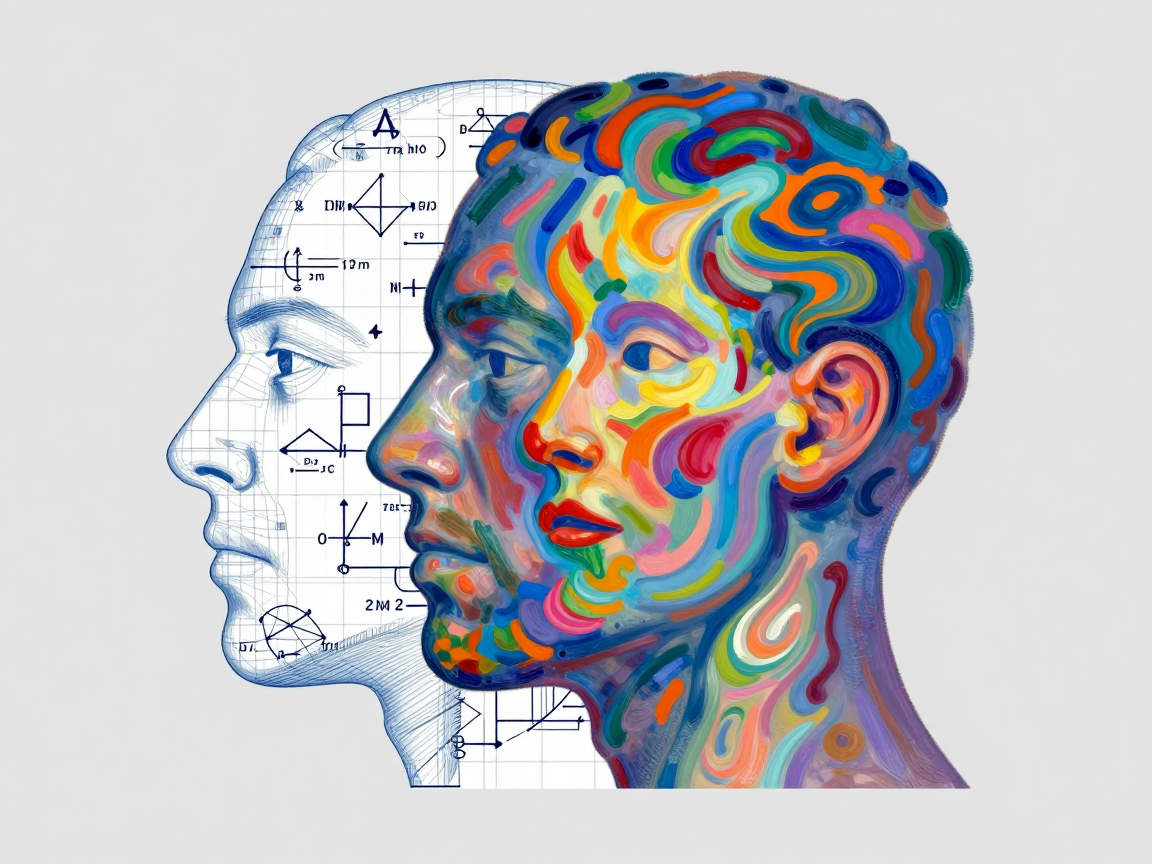
Imagine two people sitting in a cafe. The digital thermometer on the wall reads exactly 68 degrees. This number is a measurable, verifiable fact. It exists whether or not anyone is there to read it. However, one person is wearing a light sweater and feels perfectly comfortable, while the other is shivering and wishing they had brought a heavy coat. Both individuals are experiencing the same environment, yet their internal versions of that environment are vastly different. This simple scenario illustrates the tension between objective vs subjective reality.
Most of our daily frustrations, conflicts, and anxieties arise from a fundamental misunderstanding of where one reality ends and the other begins. We often treat our personal interpretations as if they were universal laws, leading to a rigid mindset that keeps us stuck. By learning to distinguish between the hard facts of the external world and the soft interpretations of our internal world, we can develop a more flexible, resilient, and accurate way of living. This guide explores the mechanics of perception and offers a framework for navigating the gap between what is happening and what we think is happening.
Defining the Divide: What is Objective vs Subjective Reality?
To understand the world, we must first categorize how we receive information. Objective reality refers to the world as it exists independently of any observer. It is composed of physical laws, mathematical constants, and empirical facts. If all humans were to disappear tomorrow, gravity would still pull objects toward the center of the Earth, and water would still freeze at zero degrees Celsius. This is the reality of the "what" - the raw data of existence that can be measured with instruments and validated through the scientific method.
Subjective reality, on the other hand, is the world of the "how". It is the internal landscape of thoughts, feelings, memories, and interpretations. It is the unique filter through which we process the objective world. Subjective reality is not necessarily "false", but it is deeply personal. Your favorite color, your fear of spiders, and your feeling that a specific piece of music is "beautiful" are all components of your subjective reality. These experiences are undeniably real to you, but they do not exist as physical constants in the external world.
Critically, the human experience is almost entirely a dance between these two realms. We rarely interact with objective reality in its pure form. Instead, our brains take the raw, objective data from our senses and immediately wrap it in a layer of subjective meaning. When we say, "The weather is terrible today", we are blending the objective (it is raining) with the subjective (I dislike rain). Understanding this blend is the first step toward mental sovereignty.
The Hardware of Perception: Why Your Brain is a Prediction Machine
For a long time, scientists believed that the human eye was like a camera and the brain was like a video screen, simply recording the objective world. Modern neuroscience has revealed a much more complex picture. The brain actually sits in a dark, silent skull, receiving nothing but electrical impulses from the senses. To make sense of these impulses, the brain acts as a prediction machine.
Instead of waiting for information to arrive, your brain constantly builds a model of what it expects to see, hear, and feel. It then uses the incoming sensory data to correct those predictions. This means that a large portion of what you perceive as the "outside world" is actually an internal simulation generated by your brain. This is why two people can look at the same political event or social interaction and see two completely different things. Their brains are using different past experiences and biases to construct their subjective versions of the event.
This biological bottleneck is the primary reason why objective vs subjective reality can feel so blurred. We are hardwired to believe that our perceptions are direct reflections of truth. In psychology, this is known as "naïve realism" - the tendency to believe that we see the world exactly as it is, and that people who disagree with us are either uninformed, irrational, or biased. Recognizing that our brain is a filter rather than a window allows us to approach life with more humility and curiosity.
The Collective Subjective: When Many Minds Agree
There is a fascinating middle ground between the objective and the subjective that often goes unnoticed. This is the realm of the collective subjective, or intersubjectivity. These are things that do not exist in the physical world of atoms and molecules but are treated as objective facts because enough people agree on them.
Consider the concept of money. A twenty - dollar bill is objectively just a piece of paper with specific ink patterns. It has no inherent value in the laws of physics. However, because millions of people subjectively agree that it represents value, it functions as an objective force in our lives. You can buy food with it, pay rent with it, and lose sleep over it. The same applies to laws, corporations, and social norms. These are subjective constructs that carry the weight of objective reality because they are shared.
Understanding this layer helps us navigate society more effectively. It allows us to see that many of the "rules" we live by are not fixed laws of nature, but rather agreements that can be renegotiated. It also highlights how powerful our subjective beliefs can be when they are scaled up across a community or culture.
The Reality Audit: A 5-Step Practice for Mental Clarity
When we find ourselves stressed, angry, or overwhelmed, it is usually because we have confused our subjective interpretation for an objective fact. To regain balance, we can use a framework called the Reality Audit. This practice helps disentangle the two realities so we can respond to life with more precision.
1. Strip Away the Adjectives
Identify the situation that is causing you distress. Now, remove every adjective and emotional descriptor from your description. If your thought is "My boss gave me a cruel and unfair performance review", the objective version is "My boss gave me a performance review that contained specific criticisms". By removing the adjectives, you move from the subjective emotional charge toward the objective data points.
2. Identify the Narrative
Ask yourself: "What story am I telling myself about these facts?". Every subjective reality is built on a story. In the example above, the story might be "My boss hates me" or "I am going to get fired". Recognizing the story as a separate entity from the facts creates space for alternative interpretations. You realize that the story is something your brain created to fill the gaps in the raw data.
3. Seek the Physical Evidence
What can be proven in a court of law? If you were to show a video of the event to a stranger, what would they see? This step forces you to look at the objective vs subjective reality divide through an external lens. It grounds you in what is measurable - the words that were actually said, the time something occurred, or the physical actions that were taken.
4. Check for Omissions
Our subjective filters are highly selective; they tend to highlight information that supports our current mood and ignore information that contradicts it. Ask yourself what you might be leaving out. Was your boss having a stressful day? Did the review also contain positive feedback that you glossed over? Finding the missing objective data often softens the subjective narrative.
5. Choose a Useful Perspective
Since we cannot escape subjective reality entirely, the goal is not to be perfectly objective - which is impossible for a human - but to choose a subjective interpretation that is useful. Instead of the story "I am a failure", you might choose the story "This review highlights specific skills I need to improve to reach the next level". Both are subjective interpretations, but one leads to growth while the other leads to paralysis.
Why Bridging the Gap Changes Your Relationships
Most relationship conflicts are actually battles over objective vs subjective reality. Partners often argue over "what happened", but they are actually arguing over whose subjective interpretation is the "correct" one. When you stop fighting over the objective truth and start acknowledging the subjective experience, the dynamic shifts.
Instead of saying, "You were being rude", which is a subjective judgment presented as an objective fact, you can say, "When you spoke over me, I felt dismissed". This shift acknowledges the objective action (speaking over someone) while taking ownership of the subjective response (feeling dismissed). It invites the other person to understand your internal world rather than forcing them to defend their character. This clarity is the foundation of high-level emotional intelligence.
The Power of the Observer
There is a profound sense of freedom that comes from realizing that while you cannot always control objective reality, you are the primary architect of your subjective reality. You do not have to be a victim of your own perceptions. You can learn to observe your thoughts as they arise, recognize them as subjective "weather patterns", and decide how much weight to give them.
This does not mean living in a state of denial or ignoring the hard facts of life. On the contrary, it means respecting the objective world enough to see it clearly, while respecting yourself enough to curate an internal world that is healthy and empowering. When you master the distinction between objective vs subjective reality, the world stops being a source of constant friction and starts becoming a place of infinite possibility.
Moving Toward Integrated Reality
In the end, the goal is not to live entirely in the objective or the subjective. A life of pure objectivity would be cold, robotic, and devoid of meaning. A life of pure subjectivity would be chaotic, delusional, and disconnected from others. The path to a fulfilling life lies in the integration of both.
We must remain grounded in the physical facts of our existence - our health, our finances, and our actions - while consciously crafting the meaning we assign to those facts. By standing at the intersection of objective vs subjective reality, we gain the ability to see the world as it is, while simultaneously creating the world as we want it to be. This is the essence of wisdom: knowing what is a fixed wall and what is merely a door that we have not yet learned how to open.