Why You Only See What You’re Looking For: The Reticular Activating System Explained
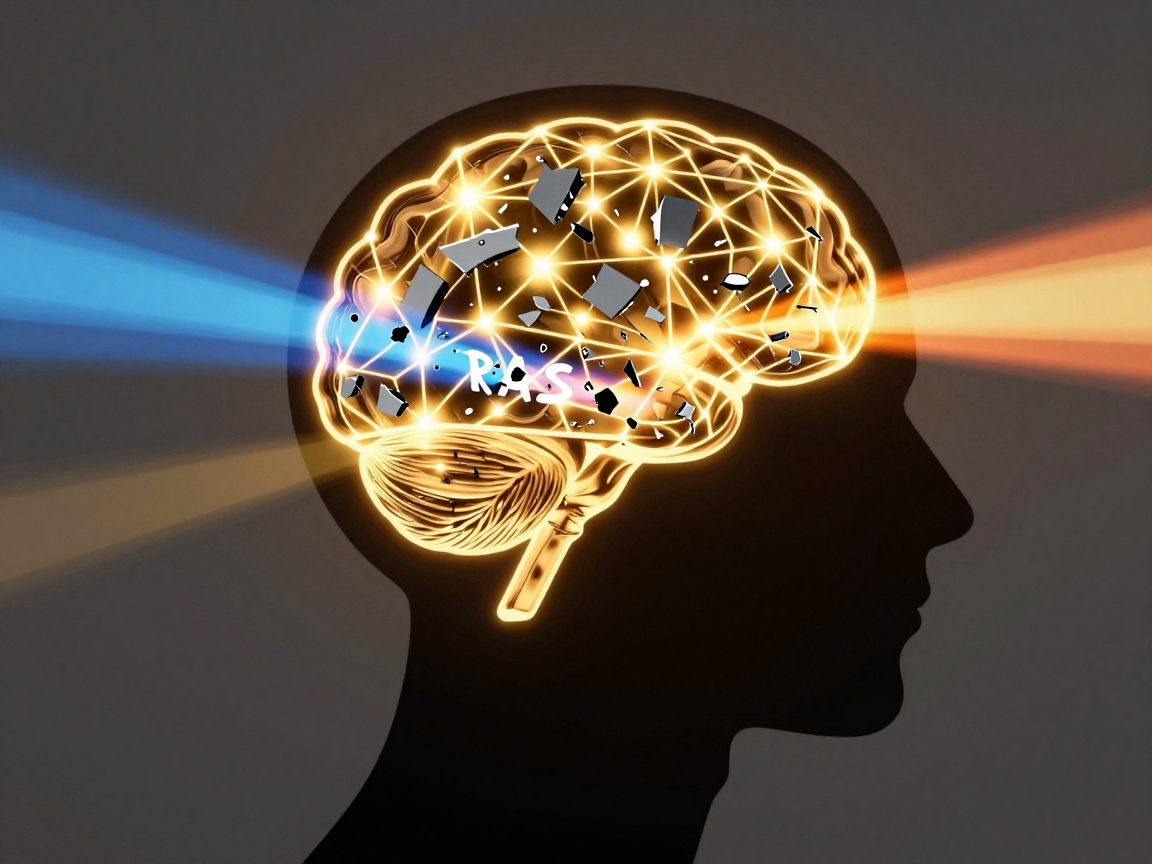
Every second, your brain is bombarded by roughly eleven million bits of sensory data. From the subtle hum of a distant air conditioner and the specific texture of the chair beneath you to the myriad of visual stimuli dancing in your peripheral vision, the sheer volume of information is staggering. If you were consciously aware of every single data point simultaneously, your mind would be paralyzed by a sensory flood. To prevent this catastrophic overload, your brain employs a sophisticated biological gatekeeper that decides which information reaches your awareness and which is discarded as noise.
This security guard is a small but mighty bundle of nerves located in your brainstem. When you have the reticular activating system explained, you begin to understand that the reality you perceive is not a direct, objective mirror of the world, but a highly curated highlight reel. By learning how this system operates, you gain the master key to your own perception, allowing you to influence what your brain notices and, by extension, the opportunities you attract and the life you build.
The Biological Gatekeeper: The Anatomy of Your Focus
To have the reticular activating system explained properly, we must first look at its physical structure. The RAS is a network of neurons located in the brainstem, extending from the medulla through the pons and into the midbrain. It serves as a bridge between the lower sections of the brain—which handle basic survival and automatic functions—and the higher sections like the cerebral cortex, which manage complex thought, decision-making, and consciousness.
While the RAS is physically small, its influence is comprehensive. It connects to the thalamus, the hypothalamus, and the entire cerebral cortex. In the most literal sense, it is the "on/off" switch for your consciousness. When the RAS is active, you are awake, alert, and engaged with the world. When its activity slows down, you transition into sleep. In cases of severe damage to the RAS, a person can enter a permanent coma because the brain loses its ability to "wake up" the higher processing centers.
Beyond just physical arousal, the RAS acts as the brain’s primary filter. It evaluates every incoming signal and asks one fundamental question: "Is this relevant to survival or current objectives?" If the signal is deemed irrelevant, it is suppressed. If it is deemed important, the RAS sends a surge of electrical activity to the cortex, effectively shouting at your conscious mind to pay attention. This is why you can sleep through a thunderstorm but wake up instantly if a floorboard creaks in your hallway—your RAS has been programmed to ignore the "noise" of the storm but prioritize the "threat" of a potential intruder.
The Filter Mechanism: Why You See Red Cars Everywhere
The most fascinating aspect of the reticular activating system explained is its role in selective attention. Because your brain has limited cognitive bandwidth, the RAS uses specific criteria to determine what makes the cut. It prioritizes information that is physically threatening, novel, or personally significant. This phenomenon is often illustrated by the "Cocktail Party Effect." Imagine you are in a crowded, noisy room where dozens of people are talking at once. You aren't consciously hearing any specific conversation until someone across the room mentions your name. Suddenly, your focus shifts with laser precision. Your RAS was monitoring the noise all along, but it only alerted you when a piece of data matched your internal "priority list."
This filtering mechanism explains why your personal experiences can be so radically different from those around you. Think back to a time when you decided to buy a specific model of car. Within days, you likely started seeing that exact car on every street corner. Did the manufacturer suddenly flood the streets with that model? Of course not. Those cars were always there, but they were previously filtered out as "background noise." The moment you focused on that car, you updated your RAS search terms, and the system began flagging every match in your environment.
This biological process plays a massive role in cognitive biases, particularly confirmation bias. Once you hold a belief or a specific focus, your RAS begins to seek out evidence that supports it while ignoring evidence that contradicts it. If you believe that the world is a hostile, difficult place, your RAS will highlight every scowl in a crowd and every negative headline. Conversely, if you are focused on growth and contribution, your RAS will start to flag resources, connections, and ideas that were always there but previously hidden in plain sight.
The RAS Reprogramming Protocol: A 5-Step Action Plan
You do not have to be a passive victim of your brain's default settings. One of the most empowering parts of having the reticular activating system explained is realizing that you can consciously program this filter. Since the RAS responds to what you focus on most frequently and emotionally, you can use specific techniques to "reset" its parameters.
1. Define Precise Search Terms
Think of your RAS like a search engine. If you give it vague queries like "success" or "happiness," it won't know what to look for. To take control, you must be hyper-specific. Instead of saying "I want to grow my business," try "I am looking for three high-value networking opportunities in the tech sector this month." The more concrete the image, the easier it is for the RAS to recognize the match.
2. Practice Somatic Visualization
The RAS is closely linked to the limbic system, which processes emotions. When you visualize a goal, don't just see it as a flat image; feel the physiological response of achieving it. Engage your senses. What does it smell like? What does your body feel like? The brain struggles to distinguish between a vividly imagined event and a real one. By "pre-playing" your success with emotion, you are signaling to the RAS that this information is of high survival value.
3. Conduct a Digital and Social Audit
If you spend your morning scrolling through negative news or outrage-driven social media, you are effectively telling your RAS that "conflict" and "threat" are your top priorities. It will then spend the rest of the day scanning your environment for more reasons to feel anxious. Guard your inputs carefully. Curate your environment so that the information hitting your eyes and ears aligns with the person you want to become.
4. Implement "Command" Statements
Affirmations often fail because they feel like lies to the conscious mind. Instead, use "Search Commands." Statements like, "I am now looking for evidence of my own capability," or "I am noticing new opportunities for creative expression," provide the RAS with a job to do. You aren't claiming the result is already here; you are instructing the gatekeeper to look for the building blocks.
5. The Evening Reflection Loop
Just before you sleep, your brain transitions into alpha and theta wave states, making the RAS highly impressionable. Review three things that went well or three small wins that align with your goals. This primes the RAS during its transition into the sleep cycle, reinforcing those patterns as important for the next day's filtering process.
Why Visualization is Applied Neurobiology
For a long time, visualization was dismissed as "woo-woo" or purely spiritual. However, with the reticular activating system explained through the lens of modern neuroscience, we can see it is actually a practical exercise in neural priming. When you visualize, you are creating a neural template. The RAS then uses this template as a reference point to scan the external world.
Consider the "luck" vs. "unluck" studies performed by psychologists. They found that people who identify as "lucky" are generally just better at noticing unexpected opportunities. Their RAS is programmed to look for the "win," whereas people who identify as "unlucky" have an RAS programmed to look for the "risk" or the "failure." By applying the programming protocol, you aren't magically manifesting things out of thin air; rather, you are finally noticing the resources, people, and paths that were previously obscured by your own internal filtering system.
Overcoming the "Doom-Loop": Fixing a Negative RAS
Sometimes, the RAS can become calibrated toward negative or limiting patterns, often as a result of past trauma or chronic stress. When this happens, it becomes a "doom-loop" where the brain only sees evidence of failure or rejection. If you find yourself frequently experiencing the following, your filter might need a recalibration:
- Chronic Pessimism: You can find the "catch" or the "downside" in every positive situation almost instantly.
- The "Always/Never" Trap: You notice every time someone lets you down, reinforcing the belief that "people always let me down," while ignoring the dozens of times people were reliable.
- Hyper-Vigilance: You are constantly scanning for social slights or threats, leaving you feeling exhausted and anxious.
- Stagnation: You feel like there are no opportunities available to you, even when those around you are finding success.
If these patterns feel familiar, start small. You cannot rewrite a lifetime of neural filtering in an afternoon. Begin by consciously looking for one small, positive thing each day—even something as simple as a green light when you're in a rush. This simple act of "manual override" slowly shifts the RAS's default settings over time.
The Power of Intentional Focus
Understanding the reticular activating system explained is essentially about reclaiming your cognitive sovereignty. We live in an era of digital distraction where every app, advertisement, and notification is vying for a piece of your attention. If you do not consciously choose what to focus on, your RAS will be hijacked by the loudest and most urgent signals in your environment—usually things that provoke fear or anger.
Taking control of your RAS allows you to move from a state of reaction to a state of intention. By giving your brain a clear set of instructions, you transform your mind from a cluttered storage unit into a precision-guided tool. The world is vast and filled with endless data points; ensure your gatekeeper is letting in the ones that help you build the life you want. Your focus is your most valuable currency—spend it on the reality you wish to inhabit.