The Unreasonable Effectiveness of Numbers: Decoding the Mathematics of the Universe
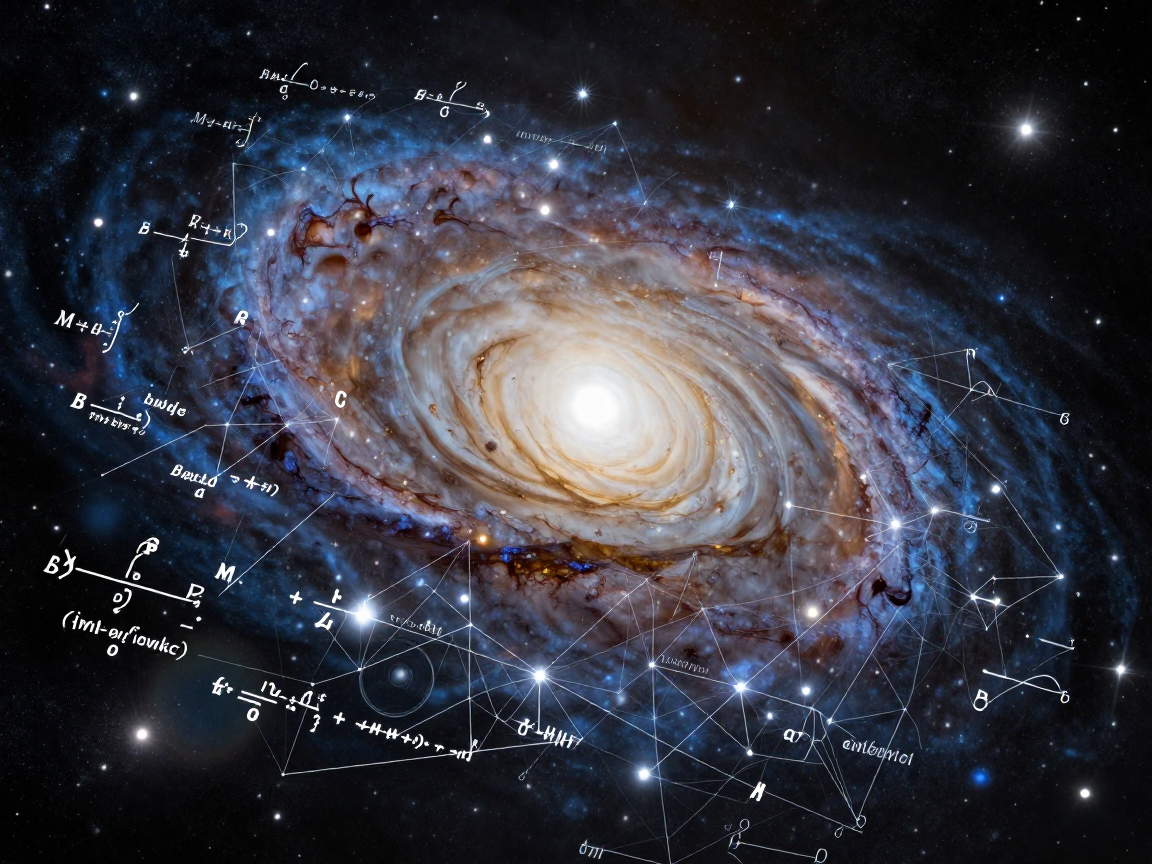
When we look up at the night sky, we see a vast, seemingly chaotic expanse of stars, nebulae, and dark voids. To the ancient observer, this was a realm of gods and myths, a tapestry woven with stories. Yet, beneath this visual grandeur lies a rigid, elegant, and invisible framework. Every orbit, every flickering light, and every collision of celestial bodies follows a set of rules so precise they can be described on a single sheet of paper. This is the mathematics of the universe - a phenomenon where abstract symbols and logic dictate the behavior of physical reality.
The most baffling aspect of our existence is not that the world is complex, but that it is comprehensible. Why should a circle drawn on a piece of paper in a classroom share the same geometric properties as the ripples in a pond or the orbit of a planet around a sun? This deep connection between the human mind's capacity for logic and the physical world's behavior suggests that math is not just a tool we invented, but the very fabric from which the cosmos is cut. To understand the mathematics of the universe is to peek behind the curtain of reality and see the blueprint of creation.
The Fibonacci Sequence and Nature's Aesthetic Logic
One of the most recognizable ways the mathematics of the universe manifests is through the Fibonacci sequence. This numerical pattern - 0, 1, 1, 2, 3, 5, 8, 13, 21, and so on - is formed by adding the two previous numbers together. While it seems like a simple classroom exercise, this sequence creates the Golden Ratio, a proportion that appears with startling frequency in the natural world.
You can find these proportions in the arrangement of seeds in a sunflower, the spiral of a nautilus shell, and the structure of pinecones. This isn't a coincidence or a result of nature having an aesthetic preference. It is a matter of efficiency. The Golden Ratio allows for the most compact packing of elements, ensuring that a plant can fit the maximum number of seeds in a limited space or that a shell can grow without changing its shape. Even at a cosmic scale, the spiral arms of certain galaxies mirror these same mathematical curves, proving that the same rules governing a garden also govern the movement of billions of stars.
The Language of Gravity and the Geometry of Space
For centuries, humans believed that space was a static stage upon which the drama of the universe played out. Isaac Newton used the mathematics of the universe to describe gravity as a force that pulled objects together, providing the equations that predicted planetary orbits with incredible accuracy. However, Albert Einstein took this further by realizing that gravity wasn't just a force - it was geometry.
In his General Theory of Relativity, Einstein proposed that space and time are fused into a four - dimensional fabric called space - time. Massive objects, like the sun, warp this fabric, much like a bowling ball sitting on a trampoline. The math required to describe this warping involves non - Euclidean geometry, a branch of mathematics that deals with curved surfaces. When we see a planet orbiting a star, we are witnessing that planet following the shortest mathematical path through curved space. This revelation showed that the mathematics of the universe is not just about numbers; it is about the very shape of existence.
Quantum Mechanics: The Mathematics of Probability
While the macro world of planets and stars follows the predictable math of gravity, the subatomic world operates on a completely different set of rules. Quantum mechanics introduces a version of the mathematics of the universe that is rooted in probability rather than certainty. At the level of electrons and photons, particles do not exist in one specific place until they are observed. Instead, they exist in a cloud of possibilities described by a wave function.
This mathematical framework, developed by thinkers like Erwin Schrödinger and Werner Heisenberg, is famously counter - intuitive. It suggests that at its most fundamental level, reality is a series of mathematical probabilities. We cannot say for certain where a particle is; we can only use math to calculate the likelihood of finding it there. This leads to the staggering realization that the solid world we touch and see is actually built upon a foundation of fluctuating mathematical waves. Without these complex equations, we would have no way to build the transistors that power our computers or the lasers used in modern medicine.
A Practical Framework: How to Recognize Universal Math in Daily Life
Understanding the mathematics of the universe does not require a PhD in physics. You can begin to see these patterns by shifting how you observe your surroundings. Use this framework to identify the mathematical signatures of reality in your everyday environment:
- Search for Fractals: Look at the branch of a tree, a river delta, or a lightning bolt. Notice how the small parts look like miniature versions of the whole. This is self - similarity, a mathematical concept defined by fractal geometry.
- Observe Symmetry: Look at a butterfly's wings or a snowflake. Nature uses bilateral and radial symmetry to create balance and stability, a principle deeply rooted in group theory and geometry.
- Identify Inverse Squares: Notice how the brightness of a candle drops off rapidly as you move away, or how the heat of a fire fades. This follows the inverse - square law, where the intensity is inversely proportional to the square of the distance.
- Track the Power of Three: Many physical systems, from the phases of matter (solid, liquid, gas) to the dimensions of space (length, width, height), are organized in groups of three, reflecting the underlying structural constraints of our reality.
- Monitor Cycles and Sine Waves: Listen to the pitch of a passing siren or watch the tides. These rhythmic fluctuations are represented by sine waves, the mathematical language of oscillation and frequency.
The Mystery of Universal Constants
Perhaps the most compelling evidence for the mathematics of the universe lies in the existence of universal constants. These are fixed numbers that never change, no matter where you are in the cosmos. They are the settings on the cosmic dashboard. Examples include:
- The Speed of Light (c): The absolute speed limit of the universe, roughly 299,792,458 meters per second.
- The Gravitational Constant (G): The number that determines the strength of the pull between two masses.
- Planck's Constant (h): The value that sets the scale for quantum effects.
- The Fine - Structure Constant: A number that characterizes the strength of electromagnetic interactions.
Physicists have noted that if these numbers were even slightly different - by as little as one percent - the universe as we know it could not exist. Atoms would not hold together, stars would not ignite, and life would be impossible. This leads to the deep philosophical question of why these specific numbers exist. Are they random, or are they the only possible values that a stable universe can have? Regardless of the answer, the fact that our reality is fine - tuned by specific numerical values is a testament to the mathematical nature of our origin.
Is Math a Human Invention or a Cosmic Discovery?
This brings us to one of the greatest debates in the history of thought. Do we invent mathematics to describe what we see, or do we discover it because it was already there? Most mathematicians and physicists lean toward the latter. They argue that if we were to meet an alien civilization from the other side of the galaxy, they might have different symbols for numbers and different names for shapes, but their version of the Pythagorean theorem would be identical to ours.
The mathematics of the universe is a universal language. It transcends culture, time, and even biology. When we send signals into deep space, such as the Arecibo message, we use prime numbers and mathematical constants because we assume that any intelligent being would recognize them as the fundamental building blocks of logic. Math is the bridge between different forms of intelligence, a shared reality that exists outside of human opinion or emotion.
Conclusion: The Beauty of the Calculated Cosmos
Viewing the world through the lens of the mathematics of the universe changes our perspective on existence. It takes the mystery of the unknown and replaces it with the awe of the understood. We begin to see that we are not living in a world of random accidents, but in a highly ordered system where even the smallest atom follows a grand design of logic and proportion.
This realization brings a sense of profound connection. We are made of the same atoms that follow the same mathematical laws as the furthest quasars. When we solve a complex equation or admire the symmetry of a flower, we are engaging with the very language that the universe uses to speak. Mathematics is more than just a subject in a textbook; it is the heartbeat of the cosmos, the silent music of the spheres, and the ultimate proof that there is sense to be made of the vastness surrounding us. By learning to read this language, we don't just learn about the world - we learn about our place within its infinite, calculated beauty.