Beyond Random Chance: How to Distinguish Meaningless Coincidences from True Synchronicity
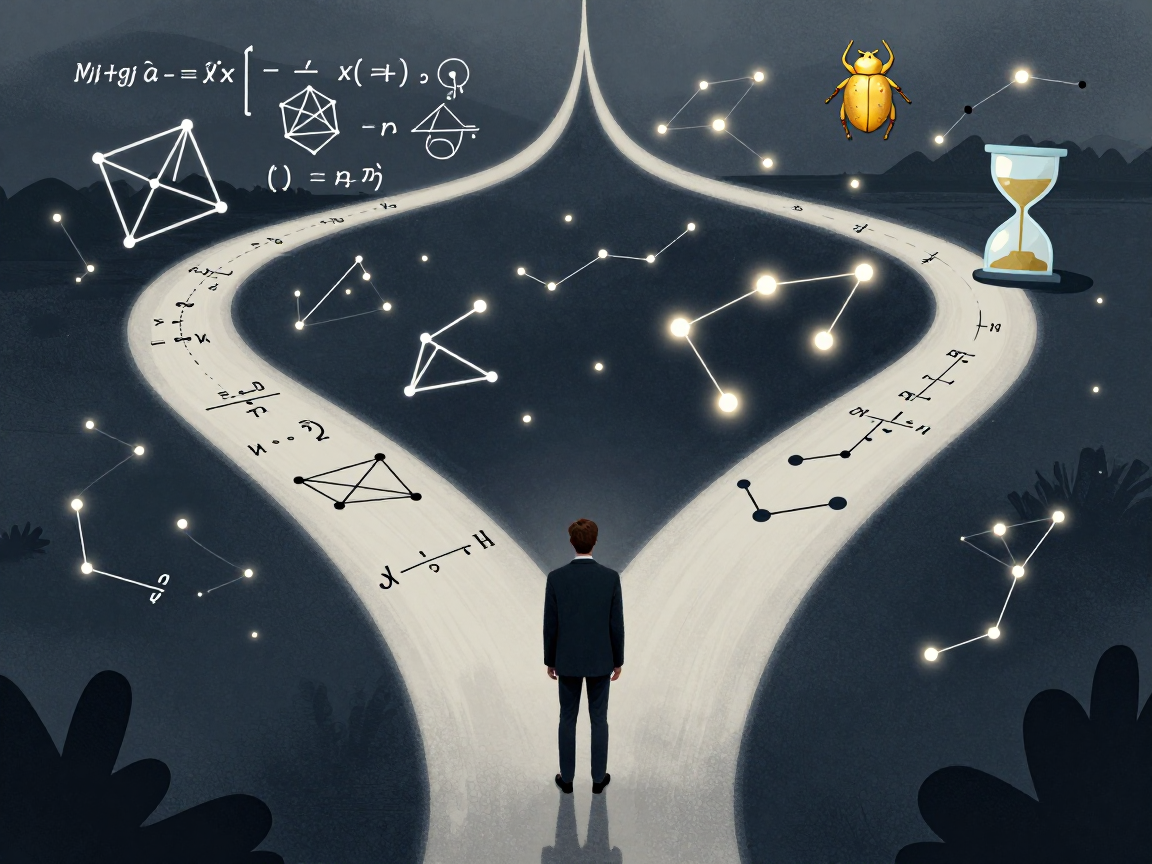
Most of us have experienced that peculiar moment where the world seems to align in a way that defies logic. Perhaps you were thinking of a childhood friend you haven't spoken to in a decade, only to have them text you five minutes later. Or maybe you were struggling with a specific career decision and happened to overhear a stranger in a coffee shop discussing the exact solution you needed. These moments often leave us pausing, wondering if we are witnessing a glitch in the matrix or a profound message from the universe.
At the heart of these experiences lies the debate of coincidences vs synchronicity. While the two terms are often used interchangeably in casual conversation, they represent fundamentally different ways of viewing reality. One is rooted in the cold, hard mathematics of probability and random chance, while the other suggests a deeper, underlying connection between our internal thoughts and the external world. Understanding this distinction is not just an academic exercise—it is a way to better navigate your intuition and recognize when the universe might actually be trying to get your attention.
The Mechanics of Coincidence: A World of Pure Probability
To understand the nuances of coincidences vs synchronicity, we must first look at the statistical side of the coin. A coincidence is defined as a remarkable concurrence of events or circumstances without apparent causal connection. From a scientific and mathematical perspective, coincidences are not just possible; they are inevitable. This is often explained by the Law of Truly Large Numbers, which states that with a large enough sample size, any outrageous thing is likely to happen.
Consider the famous "birthday paradox." In a room of just 23 people, there is a 50 percent chance that two of them share the same birthday. To the individuals involved, it feels like a one-in-a-million occurrence, a magical alignment. To a mathematician, it is a predictable outcome of probability. This is the essence of a coincidence—it is an objective event that occurs due to the sheer volume of variables constantly interacting in our lives. There is no "why" behind a coincidence other than the fact that in a world of eight billion people, the improbable happens every single day.
Psychologists also point to "Littlewood's Law," which suggests that a person can expect to experience a "miracle" at the rate of about one per month. If we define a miracle as an event that has a million-to-one chance of happening, and we consider that we see and hear things for about eight hours a day, the math dictates that these statistical anomalies are actually quite common. In the framework of coincidences vs synchronicity, a coincidence is the "noise" of a complex system, whereas synchronicity is thought to be the "signal."
The Jungian Perspective: What Makes an Event Synchronistic?
If coincidence is about math, then synchronicity is about meaning. The term was coined by the Swiss psychologist Carl Jung, who was fascinated by events that seemed to be connected by meaning rather than cause and effect. Jung defined synchronicity as an "acausal connecting principle." He argued that the human psyche and the physical world are not separate entities but are deeply intertwined. When an internal state (like a dream, a feeling, or a thought) aligns perfectly with an external event, Jung believed it was a manifestation of the "Unus Mundus"—the underlying unity of reality.
Jung's most famous example involved a patient who was overly rational and difficult to treat. One day, she was telling him about a dream in which she was given a golden scarab. At that exact moment, a literal golden scarab beetle (a Cetonia aurata) began tapping against the window of the office. Jung caught the beetle and handed it to her, saying, "Here is your scarab." This event broke through her rational defenses and allowed her therapy to progress.
In the context of coincidences vs synchronicity, the appearance of the beetle was not just a random statistical fluke. It was the "meaning" of the beetle—its symbolic weight in the patient's dream and the timing of its arrival—that transformed it into a synchronicity. Synchronicity requires an observer. Without a person to derive meaning from the event, it remains a simple coincidence. This is a crucial distinction: synchronicity is a bridge between the objective world and the subjective soul.
Coincidences vs Synchronicity: Five Defining Differences
Distinguishing between a random fluke and a meaningful sign can be challenging. However, when we analyze coincidences vs synchronicity, several key differentiators emerge that help us categorize our experiences. If you find yourself wondering which one you are dealing with, look for these five hallmarks.
1. The Presence of Symbolic Meaning
In a coincidence, the events are related by data or facts. For example, you and a stranger both wearing the same niche band t-shirt is a coincidence. In a synchronicity, the event carries a symbolic weight that relates to your current life path, a problem you are solving, or an emotional state. The event feels like a "metaphor" brought to life.
2. The Emotional Impact
A coincidence might make you say, "That is weird." A synchronicity, however, usually carries a physical or emotional charge. You might feel a chill down your spine, a sudden sense of peace, or an intuitive "knowing" that you are on the right track. This emotional resonance is often the most reliable way to tell the difference.
3. Timing and Precision
While coincidences can happen at any time, synchronicities tend to occur at "hinge points" in our lives. They arrive precisely when we are at a crossroads, in the middle of a crisis, or embarking on a major transformation. The timing feels almost theatrical, as if the universe has perfect comedic or dramatic delivery.
4. Frequency and Clustering
Coincidences are usually isolated incidents. Synchronicity often comes in clusters. You might see the same number, hear the same song, and encounter the same specific animal all within 48 hours. This "layering" of events is a classic sign that you are moving beyond simple probability and into the realm of synchronistic flow.
5. The Acausal Nature
In a coincidence, you can often trace a potential cause, even if it is a stretch. In a true synchronicity, there is no logical way the internal thought could have caused the external event. They are connected only by the meaning they share, defying the standard laws of physics and linear time.
The Science of Pattern Recognition: Why Your Brain Sees Signs Everywhere
While the spiritual or psychological interpretation of synchronicity is compelling, we must also acknowledge the role of the brain. Humans are biologically wired to be pattern-seeking creatures. This is largely due to the Reticular Activating System (RAS), a bundle of nerves at our brainstem that acts as a filter. The RAS decides what information is important enough to enter our conscious mind.
If you decide to buy a red car, you will suddenly start seeing red cars everywhere. This isn't a synchronicity; it's your RAS filtering for what you've deemed relevant. Similarly, if you are deeply focused on a specific problem, your brain will naturally "scan" the environment for anything related to that problem. This can lead to "apophenia"—the human tendency to perceive meaningful connections between unrelated things.
When debating coincidences vs synchronicity, it is important to remain grounded. Sometimes a bird is just a bird, and sometimes a license plate is just a license plate. However, the fact that our brains are designed to find meaning doesn't necessarily invalidate the meaning we find. Instead, it suggests that the world and our minds are constantly in a dance, looking for ways to communicate.
A 4-Step Framework to Evaluate Your Experiences
If you want to move beyond guesswork, you can use this simple framework to evaluate whether an event belongs in the category of coincidences vs synchronicity. Use these steps next time you experience a "glitch" in your daily life.
- The Gut Check: What was your immediate physical reaction? If you felt a sense of awe, "the chills," or a sudden "aha!" moment, it leans toward synchronicity. If you felt nothing but mild surprise, it is likely a coincidence.
- The Context Test: What were you thinking or doing thirty seconds before the event happened? Synchronicity is almost always a "response" to an internal state. If there is no connection between your inner world and the outer event, treat it as a coincidence.
- The Utility Factor: Does this event offer guidance, a solution, or a shift in perspective? Synchronicity usually serves a purpose—it acts as a nudge or a confirmation. If the event is "weird" but totally useless, it is likely just the law of large numbers at work.
- The Rule of Three: If you are unsure, wait for the "Rule of Three." A single event can be a fluke. Two events can be a coincidence. Three related events within a short period of time is almost certainly a synchronicity.
Cultivating Synchronicity: Moving Beyond Random Chance
Can you actually increase the amount of synchronicity in your life? Many psychologists and spiritual practitioners believe you can. If synchronicity is a bridge between the mind and the world, then making your mind more "receptive" naturally strengthens that bridge. This involves moving out of "autopilot" and into a state of active awareness.
Practicing mindfulness is the most effective way to do this. When you are constantly distracted by your phone or lost in loops of anxious thought, you miss the subtle alignments happening around you. By being present, you allow your RAS to pick up on the "whispers" of the environment. Additionally, setting intentions can act as a catalyst. When you clearly define a goal or a question you need answered, you are essentially "tuning" your internal radio to a specific frequency, making it more likely that you will recognize the "broadcast" when it arrives in the form of a synchronistic event.
However, there is a fine line between being open to signs and falling into "magical thinking." Not every cloud is a message, and not every delay is a "protection" from the universe. The key to mastering the balance of coincidences vs synchronicity is to stay curious but skeptical. Use the signs as data points for your intuition, but never outsource your personal agency to them.
The Bottom Line on Meaning and Math
Ultimately, the choice between viewing the world through the lens of coincidences vs synchronicity is a personal one. You can live in a world where everything is a random accident of probability, or you can live in a world where the universe is in a constant, meaningful dialogue with your soul. Both perspectives have their merits. The mathematical view keeps us grounded in reality, while the synchronistic view adds a layer of depth and enchantment to the human experience.
By learning to distinguish the noise from the signal, you can begin to trust your own path more deeply. Whether it is a "statistical fluke" or a "divine nudge," these moments of alignment serve as reminders to stop, look around, and pay attention. In a world that often feels chaotic and disconnected, the pursuit of synchronicity is a pursuit of belonging—a way to prove to ourselves that we are not just observers of reality, but active participants in its unfolding story.