Beyond the Sun Sign: Why Synastry (Relationship Astrology) Is the Secret to Understanding Your Deepest Bonds
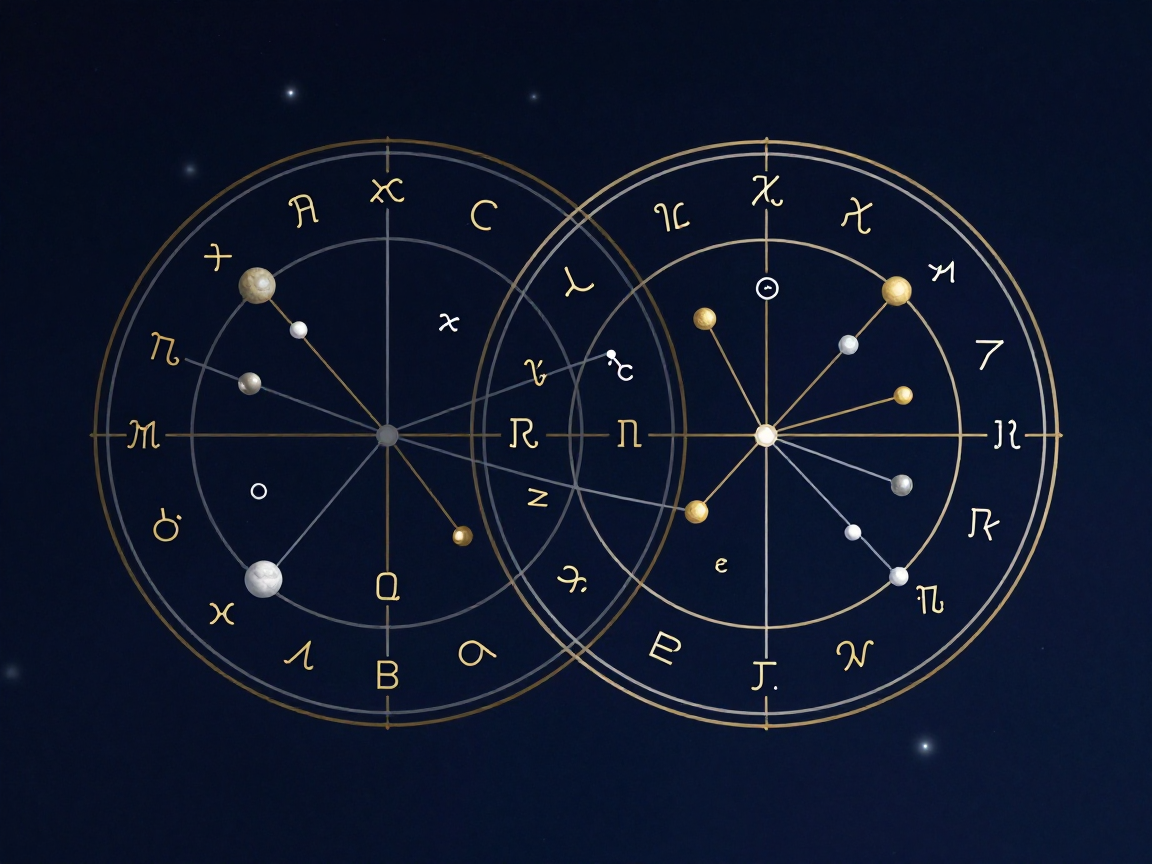
When we meet someone and feel an instantaneous, unexplainable spark, we often search for a language to describe it. We look for signs, we analyze text messages, and we wonder if our personalities are truly meant to align. While basic zodiac compatibility—the kind you find in a newspaper column—offers a glimpse into how two people might get along, it barely scratches the surface of the human experience. To truly understand the engine room of a partnership, we have to look toward synastry (relationship astrology).
Synastry (relationship astrology) is the study of how two individuals interact with one another based on their unique birth charts. It is not about whether you are a "good match" in a binary sense; rather, it is a sophisticated map that shows where you inspire each other, where you might clash, and why you feel drawn to one another in the first place. By overlaying one person's planetary positions onto another's, we can see exactly how their energies dance together, creating a complex narrative of shared growth, profound attraction, and occasional friction. It is the difference between reading a book's cover and diving deep into its most intricate chapters.
The Mechanics of Connection: What Synastry (Relationship Astrology) Actually Reveals
At its core, synastry (relationship astrology) is the art of comparison. While a birth chart is a snapshot of the sky at the moment you were born—representing your individual blueprint—a synastry report looks at the relationship as a third entity created by the intersection of two people. It answers the fundamental questions of relational mechanics: How does my Mars affect your Venus? Why does your Saturn make me feel so responsible? Why do we talk for hours when our Mercurys are in the same sign?
This practice matters because it moves us away from fatalistic ideas of "soulmates" or "bad matches." Instead, it offers a diagnostic tool for conscious relating. When you understand that your partner's silence during an argument isn't a lack of care but a result of their Saturn sitting on your Mercury, you gain the empathy needed to navigate the conflict differently. Synastry (relationship astrology) provides a mirror for the relationship, allowing both parties to see their blind spots and their collective strengths. It transforms a "problem" into a "dynamic," and once you name the dynamic, you can work with it rather than being victimized by it.
Synastry vs. Composite Charts
It is common to confuse synastry with another popular method: the composite chart. While synastry (relationship astrology) looks at the interaction between two people (Person A's Sun on Person B's Moon), a composite chart is a single chart calculated using the mathematical midpoints between two people's planets. If synastry is the "chemistry" between two people—the way they feel when they are standing in a room together—the composite chart is the "destiny" or the purpose of the relationship as a whole. Synastry tells you how you affect each other; the composite chart tells you what the relationship itself looks like to the outside world. For those looking to understand daily interactions, synastry is the primary tool of choice.
The Luminaries: Why Moon Compatibility Trumps Sun Signs
The Sun and Moon are the most vital points in any chart analysis. In synastry, the Sun represents our core identity, our ego, and our outward vitality. When your Sun makes a positive aspect to your partner's planets, you feel seen, energized, and validated by them. However, while the Sun gets all the attention in pop culture, the Moon is the true heartbeat of long-term success.
The Moon represents our emotional needs, our subconscious vulnerability, and our sense of "home." In the context of synastry (relationship astrology), Moon compatibility is often the deciding factor in whether two people can actually live together. If two people have compatible Moon signs (such as both being in Water signs like Scorpio and Pisces), there is often an unspoken emotional language. You simply "get" each other's moods without needing a translation.
Conversely, if the Moons are in harsh aspect—perhaps one person needs total emotional transparency (Moon in Scorpio) while the other needs emotional detachment and space (Moon in Aquarius)—there will be a perpetual feeling of "missing each other" in times of crisis. Synastry (relationship astrology) doesn't say these two can't be together, but it warns that they will need to build a conscious bridge between their very different emotional worlds.
The Dance of Desire: Interpreting Venus and Mars Overlays
When we talk about romance and physical chemistry, we are looking at the interplay of Venus and Mars. These two planets describe the "spark" that initiates a connection and the "heat" that sustains it.
Venus: The Language of Love
Venus governs how we give and receive love, what we value, and our aesthetic preferences. In synastry (relationship astrology), if your Venus sits on your partner's Ascendant, they will likely find you incredibly attractive and "their type." Venus aspects show us how a couple enjoys life together. Do they enjoy the same art? Do they value financial security in the same way? When Venus is well-aspected, the relationship feels harmonious and pleasant.
Mars: The Drive and the Heat
Mars governs our drive, our physical energy, and how we pursue what we want—including sexual expression and conflict. When we look at synastry (relationship astrology) for romantic attraction, the relationship between these two planets is paramount. The "Venus-Mars conjunction" is the classic indicator of high sexual chemistry. It is the archetypal pairing of the lover and the warrior. However, Mars can also indicate where we fight. If your Mars is in a hard aspect to your partner's Mars, you might find that you are constantly competing for the "driver's seat" in the relationship, leading to frequent power struggles.
The Heavy Hitters: Saturn, Pluto, and the Nodes
Not all astrology is about ease and romance. To find out if a relationship has the "glue" to last for decades, we must look at the more challenging planets and points in synastry (relationship astrology).
- Saturn (The Glue): Saturn represents structure, responsibility, and sometimes, limitation. While a "Saturn aspect" might sound heavy or boring, it is actually the indicator of commitment. Without Saturn's influence in synastry, a relationship may be fun and exciting but lack the staying power to survive real-world challenges. Saturn says, "I will stay even when it is hard."
- Pluto (The Intensity): Pluto represents transformation, power, and the deep subconscious. Strong Pluto aspects in synastry can indicate a relationship that feels "fated" or obsessive. These are the connections that change your life forever, stripping away your old ego and forcing you to evolve. While intense, these aspects require careful handling to avoid control issues.
- The North and South Nodes (Karmic Paths): Many seekers of synastry (relationship astrology) are looking for "karmic" connections. This is found in the Lunar Nodes. When someone's planet touches your North Node, they are often a catalyst for your future growth. If they touch your South Node, they may feel like someone you have known for lifetimes—comfortable, but potentially holding you back in old patterns.
A 5-Step Framework for Reading Your Synastry Chart
If you are looking at a synastry overlay for the first time, the amount of data can be overwhelming. Use this structured approach to prioritize the most important information.
- Check the Ascendant and Descendant: Look at where the other person's planets fall in relation to your rising sign. If someone has planets in your 7th House (the house of partnership), they naturally fit the mold of what you look for in a companion. This is a "green light" for serious relationship potential.
- Analyze the Moon Aspects: Find both Moons. Are they in the same element? Do they make an angle (aspect) to each other? This determines the daily comfort level and whether you can share a kitchen, a bed, and a life without constant irritation.
- Identify "Personal Planet" Conjunctions: Look for any of your personal planets (Sun, Moon, Mercury, Venus, Mars) that sit at the exact same degree as your partner's planets. These are the strongest points of connection and will be the most palpable themes in your life together. This is where the "chemistry" lives.
- Look for Saturn's Stability: Identify where Saturn is placing pressure. Is it on your Venus? (This suggests a serious, perhaps duty-bound love). Is it on your Moon? (This suggests emotional sobriety and long-term safety). A lack of Saturn aspects can sometimes mean the relationship lacks a future.
- Evaluate the 8th and 12th Houses: If your partner's planets fall in these houses, the relationship will feel very private and psychological. The 8th House brings intensity and shared resources, while the 12th House brings a spiritual, almost psychic connection that can be hard to explain to outsiders.
House Overlays: Identifying "Where" the Energy Lives
In synastry (relationship astrology), house overlays are just as important as planetary aspects. This involves looking at which of your "houses" your partner's planets fall into. This tells you the specific area of your life that this person will activate.
- 1st House Overlays: They affect your self-image. You feel very self-conscious (in a good or bad way) when they are around. This is a very physical, visible connection.
- 4th House Overlays: They feel like family. You want to cook for them, stay in with them, and build a nest. This is a deep, foundational bond.
- 5th House Overlays: This is the "fun" zone. This person sparks your creativity, your desire for play, and your romantic side. Relationships that start with 5th house overlays are often incredibly romantic and joyful.
- 10th House Overlays: This person affects your career or public standing. You might work together, or they might inspire you to climb the social or professional ladder.
Common Misconceptions: Hard Aspects Aren't Always "Bad"
One of the biggest mistakes people make when exploring synastry (relationship astrology) is assuming that "square" or "opposition" aspects (the lines of tension) mean a relationship is doomed. In reality, a chart full of only "easy" aspects (trines and sextiles) can lead to boredom and stagnation. Tension creates growth.
For example, a Mars square Mars aspect can lead to frequent bickering, but it also creates an enormous amount of energy and drive within the couple. They may be the "power couple" that builds a business together because they are always challenging each other to do more. The key is how the individuals handle that energy. A relationship without any challenging aspects often lacks the "friction" required to move forward in life. The goal isn't to find a perfect chart, but to find a chart with enough support to handle the inevitable challenges that tension brings.
Practical Ways to Use Synastry for Growth
Once you have identified the themes of your connection through synastry (relationship astrology), you can use them as a roadmap for self-improvement and relational health.
- Acknowledge the "Trigger" Points: Use the chart to identify where you tend to trigger each other's insecurities. If your partner's Pluto is on your Moon, understand that they have a natural power to move you deeply, and they must handle your emotions with extra care.
- Celebrate the Strengths: If you have a beautiful Venus-Jupiter trine, lean into that sense of abundance and joy when times are tough. Use your natural chemistry to navigate the dry spells.
- Respect the Differences: If one person has a very independent Moon (like Aquarius) and the other has a very nurturing, close Moon (like Cancer), synastry (relationship astrology) helps you understand that these are innate needs, not personal slights. It allows for the radical acceptance of the other person's nature.
Ultimately, synastry (relationship astrology) is a tool for compassion. It reminds us that we are all complex beings with different ways of processing the world. When we look at a partner through the lens of their cosmic blueprint, we stop trying to change them into a version of ourselves and start appreciating the unique way they "love." By understanding the celestial geometry of our bonds, we can navigate the mysteries of the heart with greater wisdom, grace, and intentionality.