Beyond the Zodiac: How Astrology Aspects Shape Your Internal Dialogue
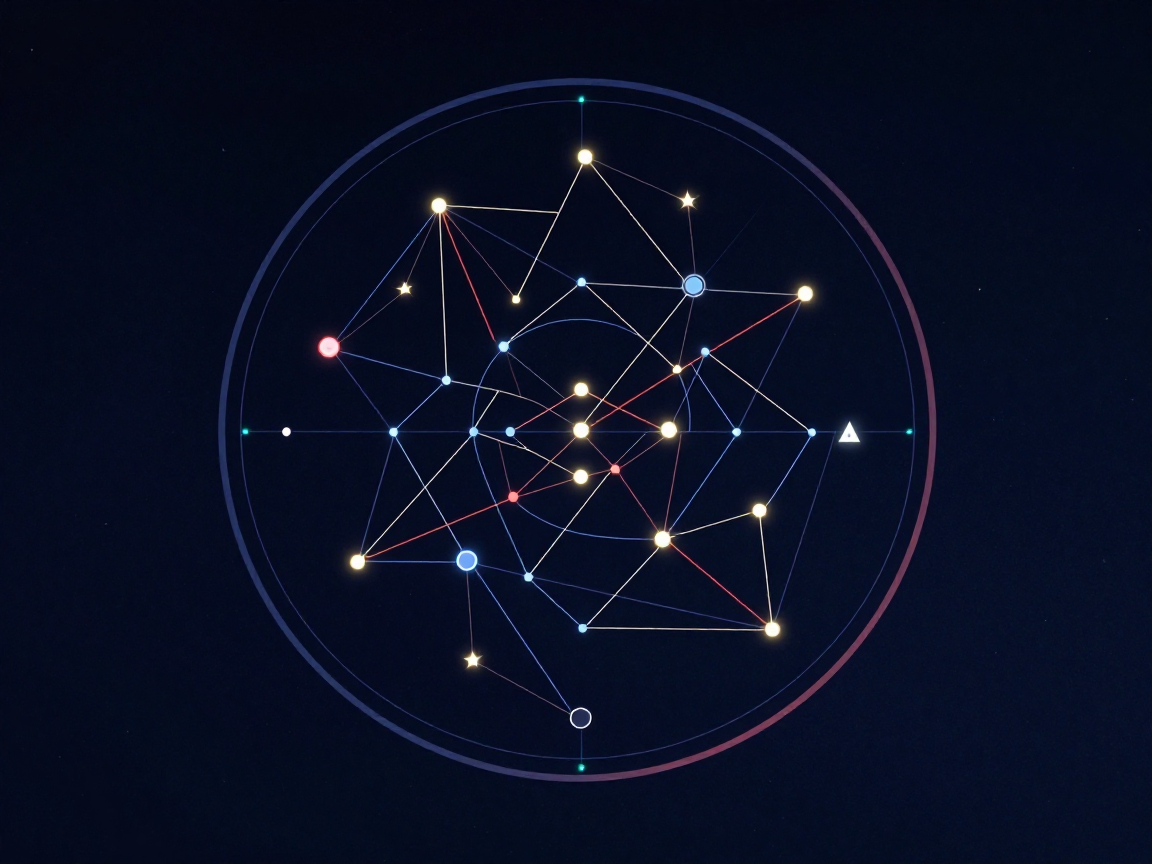
If you have ever looked at your birth chart and felt overwhelmed by the chaotic web of lines crisscrossing the center, you are not alone. Most beginners in the celestial arts focus primarily on signs and houses - the 'who' and the 'where' of their cosmic makeup. However, the true depth of a personality is found in the astrology aspects. These are the geometric relationships between planets, representing the actual conversations happening in your psyche. Without understanding these aspects, a birth chart is just a list of ingredients; with them, it becomes a complete recipe.
Think of the planets as characters in a play. Your Sun is the lead actor, your Moon is the emotional director, and Mercury is the scriptwriter. Astrology aspects represent the script itself - they determine whether these characters are supporting one another, arguing behind the scenes, or working in perfect harmony to achieve a common goal. When we study these angles, we move away from the flat descriptions of 'being a Taurus' and into the nuanced reality of being a human with conflicting desires, hidden talents, and persistent challenges.
The Geometry of the Soul: What Are Astrology Aspects?
An astrology chart is a 360-degree circle representing the sky at the exact moment of your birth. Astrology aspects are measured by the number of degrees between two planets within that circle. When planets sit at specific angles from one another, they enter into a relationship. Some angles are naturally harmonious, allowing energy to flow easily, while others create friction and tension that demand resolution.
These relationships are not just mathematical abstractions; they are the source of our internal 'tug-of-war'. For example, if your planet of love (Venus) is in a challenging aspect with your planet of discipline (Saturn), you might experience a persistent feeling that you don't deserve affection or that relationships are 'hard work'. Conversely, if they are in a harmonious aspect, you might find it incredibly easy to build long-lasting, stable commitments. Understanding these astrology aspects allows you to stop blaming yourself for 'flaws' and start working with the specific energetic blueprint you were given.
The Big Five: Understanding the Major Aspects
In traditional astrology, we primarily look at the five 'Ptolemaic' aspects. Each one has a distinct flavor and a specific way of influencing your life. By recognizing these patterns, you can begin to see why certain areas of your life feel like a breeze while others feel like a constant uphill climb.
The Conjunction (0 degrees)
The conjunction occurs when two planets are sitting right next to each other in the sky. This is a high-intensity aspect of 'fusion'. The energies of the two planets are so tightly wound together that it is often difficult for the individual to tell them apart. It is a powerhouse of focused energy, but it can also be a blind spot because the planets are too close to see each other objectively.
The Sextile (60 degrees)
A sextile is a gentle, supportive aspect. It represents a 'talent' or an 'opportunity' that requires a little bit of effort to unlock. Unlike the trine, which is effortless, the sextile offers a path that you must choose to walk down. It is often described as a friendly conversation where two planets share ideas and offer helpful suggestions to one another.
The Square (90 degrees)
Many people fear the square, but it is actually the engine of growth in a birth chart. A square creates 'friction'. Two planets are working at cross-purposes, usually because they are in signs of the same modality (Cardinal, Fixed, or Mutable) but different elements. This creates a 'turning point' energy. Squares force us to take action to resolve the internal discomfort they create. Without squares, we might never be motivated to change or improve.
The Trine (120 degrees)
The trine is often considered the most 'lucky' of the astrology aspects. When planets are in trine, they are usually in the same element (Fire, Earth, Air, or Water). This creates a natural, easy flow of energy. Talents associated with trines come so naturally that you might not even realize you have them. The only downside? Trines can sometimes lead to complacency because everything feels so 'easy'.
The Opposition (180 degrees)
As the name suggests, an opposition occurs when two planets are directly across from one another. This creates a 'seesaw' effect. You may feel like you are constantly oscillating between two extremes. The goal of an opposition is not to choose one side, but to find a 'middle ground' where both planetary needs can be met. It is an aspect of relationship and mirror-work.
The Friction of Growth: Hard vs. Soft Aspects
Astrologers often categorize astrology aspects into 'hard' (squares and oppositions) and 'soft' (trines and sextiles). Conjunctions are neutral and depend entirely on the planets involved. While our instinct is to want a chart full of soft aspects, a life without challenge rarely leads to greatness.
- Soft Aspects (The Comfort Zone): These provide the grace and ease we need to recover from life's hardships. They are the 'gifts' we are born with. However, too many soft aspects can lead to a lack of ambition or a tendency to take the path of least resistance.
- Hard Aspects (The Growth Catalyst): These are the 'challenges' that define our character. Most successful people have significant squares in their charts. The tension created by a square provides the 'grit' necessary to build something meaningful. They represent the lessons we are here to learn and the obstacles we are meant to overcome.
The Rule of Orbs: How Close Is Close Enough?
In astrology, an aspect doesn't have to be mathematically perfect to be felt. This is where the concept of 'orbs' comes in. An orb is the range of degrees within which an aspect is considered active. For example, if two planets are 88 degrees apart, most astrologers would still consider that a square, even though it isn't exactly 90 degrees.
Generally, the 'tighter' the orb (meaning the closer the planets are to the exact degree), the more powerful and noticeable the aspect will be in your life. An aspect with a 1-degree orb will be a dominant theme in your personality, while an aspect with an 8-degree orb might feel more like a background 'hum'.
A Practical Framework for Interpreting Astrology Aspects
If you are looking at your own chart and trying to make sense of these lines, use this four-step framework to synthesize the information. Instead of looking at a single aspect in isolation, try to see how it fits into the broader narrative of your life.
- Identify the 'Characters' (Planets): What two parts of your psyche are talking? Is it your drive (Mars) and your ego (Sun)? Or is it your communication (Mercury) and your expansion (Jupiter)?
- Determine the 'Tone' (The Aspect): Are they shouting at each other (Square), ignoring each other (Opposition), or singing in harmony (Trine)? This tells you the quality of the interaction.
- Consider the 'Environment' (Signs and Houses): In what area of life is this happening? A square between Mars and Saturn in the 2nd and 5th houses will play out very differently than the same square in the 10th and 1st houses. Look at the 'themes' of the houses involved.
- Synthesize the 'Conversation': Put it all together into a sentence. For example: 'My need for emotional security (Moon) is in a square with my desire for radical change (Uranus), which creates a constant internal tension between wanting to stay home and wanting to run away'.
Beyond the Basics: Minor Aspects and Dynamics
Once you have mastered the major astrology aspects, you may want to look at 'minor' aspects like the Quincunx (150 degrees) or the Semi-Sextile (30 degrees). The Quincunx, in particular, is a fascinating aspect of 'misalignment' where two planets have absolutely nothing in common, requiring constant adjustment and 'fine-tuning'.
You should also pay attention to whether an aspect is 'applying' or 'separating'. An applying aspect is one where the planets are moving toward an exact degree, making the energy feel more intense and urgent. A separating aspect is one where the planets are moving away from each other, suggesting the energy is more 'faded' or that the soul has already begun to master that particular lesson.
Integrating Your Chart's Geometry
Understanding your astrology aspects is a journey toward radical self-acceptance. When you see a square in your chart, you can stop asking 'Why am I like this?' and start asking 'How can I use this tension to create something?' When you see a trine, you can stop downplaying your talents and start leaning into them with confidence.
Your birth chart is not a static map; it is a living, breathing set of dynamics. By learning the language of astrology aspects, you gain the ability to navigate your own internal landscape with more compassion and strategy. You are not just a collection of signs; you are a complex, geometric masterpiece of cosmic energy. The lines in your chart are not 'scars' or 'obstacles' - they are the very threads that weave together the unique tapestry of your life.