Beyond Mere Coincidence: Understanding Jung Synchronicity as a Path to Greater Meaning
We have all experienced moments that feel too perfectly timed to be dismissed as simple accidents. You think of an old friend you haven't spoken to in years, and your phone rings with their name on the screen seconds later. You are struggling with a specific career dilemma, and you stumble upon a book in a coffee shop that addresses your exact problem on the first page you open. For many, these are just weird flukes of probability. But for Swiss psychologist Carl Jung, these moments were glimpses into the fundamental machinery of the universe.
Jung synchronicity is the term used to describe these "meaningful coincidences." It suggests that the internal world of our thoughts, dreams, and feelings is deeply intertwined with the external world of physical events. When these two worlds align without a direct cause-and-effect relationship, we experience a sense of awe or a "click" that signals we are on the right path. Understanding how this works can transform the way you perceive your daily life, moving you away from a sense of isolation and toward a feeling of deep connection with the world around you. By engaging with these moments, we start to see that our internal psyche is not a closed system, but a participant in a larger, objective reality that responds to our subjective needs.
Defining Jung Synchronicity: The Acausal Connecting Principle
To understand Jung synchronicity, we must first look at how we usually view the world. Most of modern science is built on the law of causality: Action A causes Result B. If you hit a billiard ball, it moves because you hit it. However, Carl Jung realized that causality couldn't explain everything. He observed that certain events occur together in a way that is highly meaningful to the observer, even though one did not cause the other. This was not a rejection of science, but an observation that our linear understanding of time and force was incomplete.
Jung defined synchronicity as an "acausal connecting principle." This means the connection between the inner state (your thought) and the outer event (the phone call) is not based on force or physical interaction, but on meaning. In Jung's view, the psyche and the physical world are actually two sides of the same coin. He used the term "unus mundus"—or one world—to describe a unified reality where mind and matter are not separate. He believed that at a deep enough level, the structure of the human mind and the structure of the physical universe share the same patterns.
When a synchronistic event occurs, the boundary between your private mind and the public world thins. It is as if the universe is providing a physical mirror for your internal psychological state. This isn't just about "good luck." It is about a structural relationship between the individual and the collective whole, suggesting that we are not just passive observers of reality, but participants in a vast, interconnected web of meaning. This connection often appears during times of high emotional intensity or life transitions, when the ego's control is weakened and the deeper layers of the psyche are activated.
The Famous Golden Scarab: The Birth of a Theory
One of the most famous examples of Jung synchronicity comes from Jung's own clinical practice. He was treating a highly rational, intellectual woman who was finding it difficult to make progress in therapy because of her rigid, logical worldview. Her education and sharp intellect served as a defense mechanism, preventing her from accessing the deeper, more irrational parts of her psyche that needed healing. She needed something to break through her skepticism—something that logic could not explain away.
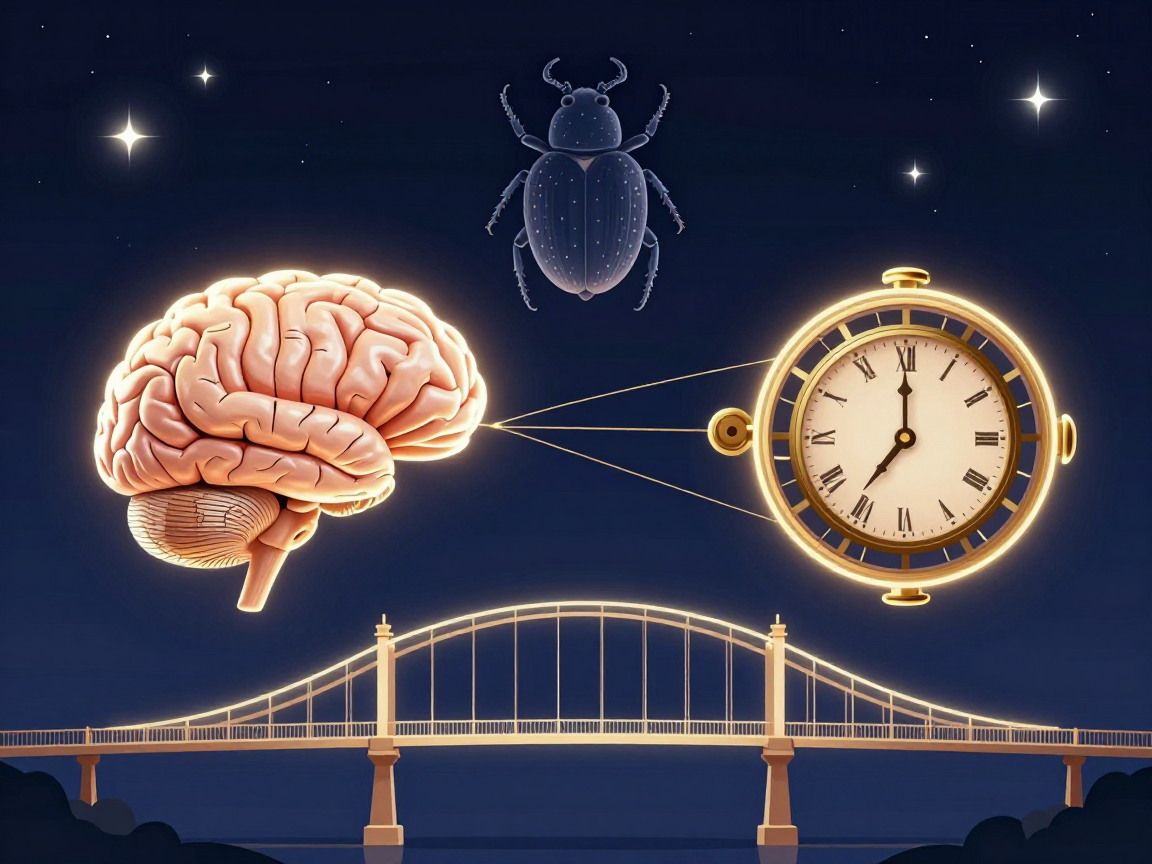
During a session, she was telling Jung about a dream she had in which she was given a piece of jewelry: a golden scarab. At that exact moment, Jung heard a tapping on the window behind him. He opened the window and caught a large insect as it flew in from the darkness. It was a scarab beetle—a cetonia aurata—which is the closest thing to a golden scarab found in that climate. Jung handed the beetle to his patient and said, "Here is your scarab."
This "meaningful coincidence" was so profound that it shattered the patient's defensive rationalism. The event allowed her to open up to the process of transformation. For Jung, the beetle wasn't "sent" by the dream, nor did the dream "cause" the beetle to fly into the window. Instead, the two events—the dream and the arrival of the insect—were linked by the theme of transformation (the scarab being an ancient Egyptian symbol of rebirth). This is the essence of Jung synchronicity: the objective world responding to the subjective need at the precise moment a breakthrough is required.
The Science of the Soul: Jung, Pauli, and Quantum Physics
It is a common misconception that Jung synchronicity is purely mystical or "New Age." In reality, Jung developed these ideas in close collaboration with Wolfgang Pauli, a Nobel Prize-winning physicist and one of the pioneers of quantum mechanics. Pauli was fascinated by the way subatomic particles seemed to behave in ways that defied classical causality, such as entanglement. Pauli himself had experienced intense psychological crises and sought Jung's help, leading to a decades-long dialogue about the intersection of mind and matter.
Pauli and Jung believed that just as physics had found "acausal" behaviors in the quantum realm, psychology had found them in human experience. They proposed that synchronicity might be the psychological equivalent of quantum entanglement. If two particles can remain connected across vast distances without a physical signal passing between them, perhaps a human mind and a physical event can be connected by a shared meaning. They envisioned a world where the laws of nature and the laws of consciousness were unified.
This collaboration suggests that Jung synchronicity is not a rejection of science, but an expansion of it. It suggests that there are laws governing the universe that we are only beginning to understand—laws that involve the observer's consciousness as a key variable. When we experience synchronicity, we are seeing the "bridge" between the subjective and the objective world in action. It challenges the purely materialistic view of the universe, suggesting that meaning is as fundamental to the cosmos as gravity or electromagnetism.
5 Signs You Are Experiencing a Genuine Synchronicity
Not every coincidence is a synchronicity. Sometimes, a coincidence is just a coincidence—the result of statistics and probability. To help distinguish between a random fluke and a meaningful event, look for these specific characteristics often associated with Jung synchronicity:
- Deep Emotional Resonance: A true synchronicity usually carries a "charge." You feel a sense of wonder, chills, or a sudden "aha!" moment. It feels significant, even if you can't immediately explain why.
- Perfect Timing: The event happens precisely when you are at a crossroads, asking a question, or experiencing a specific emotional shift. The timing is so "on the nose" that it feels scripted or orchestrated.
- Symbolic Weight: The external event often involves symbols that are personal to you or represent universal archetypes—like the scarab, a specific bird, a repeating number, or a song that holds deep memory.
- Acausality: There is no possible way your thought could have caused the external event, and no way the event could have influenced your thought in advance. They arise independently but simultaneously.
- A Sense of Guidance: Synchronicity often feels like a "nod" from the universe. It provides a feeling of being seen or supported by something larger than yourself, often providing clarity where there was previously confusion.
A Practical Framework for Navigating Meaningful Coincidences
If you want to engage more deeply with Jung synchronicity, you don't have to wait for a golden scarab to fly through your window. You can cultivate a mindset that is "synchronicity-prone." Use the following four-step framework to process and invite these moments into your life.
1. Practice Active Observation
Synchronicity requires an observer. If you are constantly distracted by your phone or lost in a loop of anxious thoughts, you will miss the subtle cues the environment is offering. Practice being "present" in your surroundings. Notice the patterns, the recurring themes, and the "random" encounters. Treat the world as if it were a dream that is trying to tell you something. This state of open awareness makes you more receptive to the subtle alignments between your mind and the world.
2. Record and Reflect
Keep a "Synchronicity Journal." Whenever a coincidence occurs that feels slightly "off" or meaningful, write it down alongside what you were thinking or feeling at that moment. Over time, you may begin to see patterns that weren't obvious in isolation. This practice signals to your subconscious that you are paying attention, which often increases the frequency of these events. It also helps you differentiate between genuine patterns and fleeting coincidences.
3. Identify the Archetypal Theme
Jung believed synchronicity was often triggered by "archetypes"—universal patterns of human experience like The Mother, The Hero, The Shadow, or Rebirth. When a coincidence happens, ask yourself: "What is the underlying theme here?" Is it about letting go? Is it about finding courage? By identifying the theme, you move from "Wow, that was weird" to "What is this teaching me?" Connecting the event to a universal human experience helps ground the meaning in psychological growth.
4. Respond with Action
Jung synchronicity is often an invitation to act. If you keep seeing references to a specific city, perhaps it is time to plan a trip there. If you meet three different people in one week who all mention the same book, read it. Synchronicity is a dialogue between you and the world; for the dialogue to continue, you must respond. Even a small action can "lock in" the meaning of the event and propel you toward the next stage of your development.
Common Pitfalls: Avoid Apophenia and Confirmation Bias
While Jung synchronicity is a powerful tool for growth, it is important to remain grounded. There is a fine line between meaningful coincidence and "apophenia"—the tendency to perceive meaningful connections between unrelated things. If you find yourself obsessively looking for signs in every license plate or every cloud formation, you may be falling into confirmation bias. This can lead to a state of "magical thinking" where one loses touch with practical reality.
True synchronicity usually finds you; you don't have to hunt for it with desperation. It has a quality of "grace" or effortlessness. If you have to perform complex mental gymnastics to make a coincidence seem meaningful, it probably isn't a synchronicity. A useful guideline is the "rule of three": if a theme appears three times in a short period through different channels, it is worth your serious attention. If it's a one-off occurrence that requires a lot of "forcing," it is best to let it go and remain focused on your present tasks.
The Role of the Collective Unconscious and Individuation
To truly grasp why Jung synchronicity happens, we have to mention the "Collective Unconscious." Jung proposed that beneath our personal memories and traits, there is a reservoir of shared human experiences and symbols. This is the source of the archetypes. When we are in a state of high emotional intensity or undergoing a major life transition, we "activate" these archetypes in the collective unconscious.
Because the collective unconscious is not bound by space or time, it can manifest its patterns in both our dreams and the physical world simultaneously. In this sense, synchronicity is the "externalization" of the collective unconscious. It is a tool for "individuation"—Jung's term for the process of becoming your true, whole self. These coincidences act as milestones on the journey, showing us that we are integrating the various parts of our psyche and aligning with our deeper purpose.
Conclusion: Living in a Meaningful Universe
Embracing the concept of Jung synchronicity doesn't mean you have to give up logic or embrace "woo-woo" thinking. Instead, it offers a more "poetic" and integrated way of living. It suggests that your life is not a series of random collisions in a cold, indifferent vacuum. Instead, you are living in a responsive environment where your inner growth is mirrored by the world around you.
By paying attention to these meaningful coincidences, you develop a "third eye" for the underlying patterns of your life. You begin to trust your intuition more, and you feel less alone in your struggles. Whether it's a scarab at a window or a chance meeting on a street corner, Jung synchronicity serves as a gentle reminder that there is a hidden symmetry to our existence—and that we are always exactly where we need to be, participating in a story that is far larger than ourselves.