Why You Feel Unfulfilled and How an Ikigai Worksheet Can Help You Reconnect with Purpose
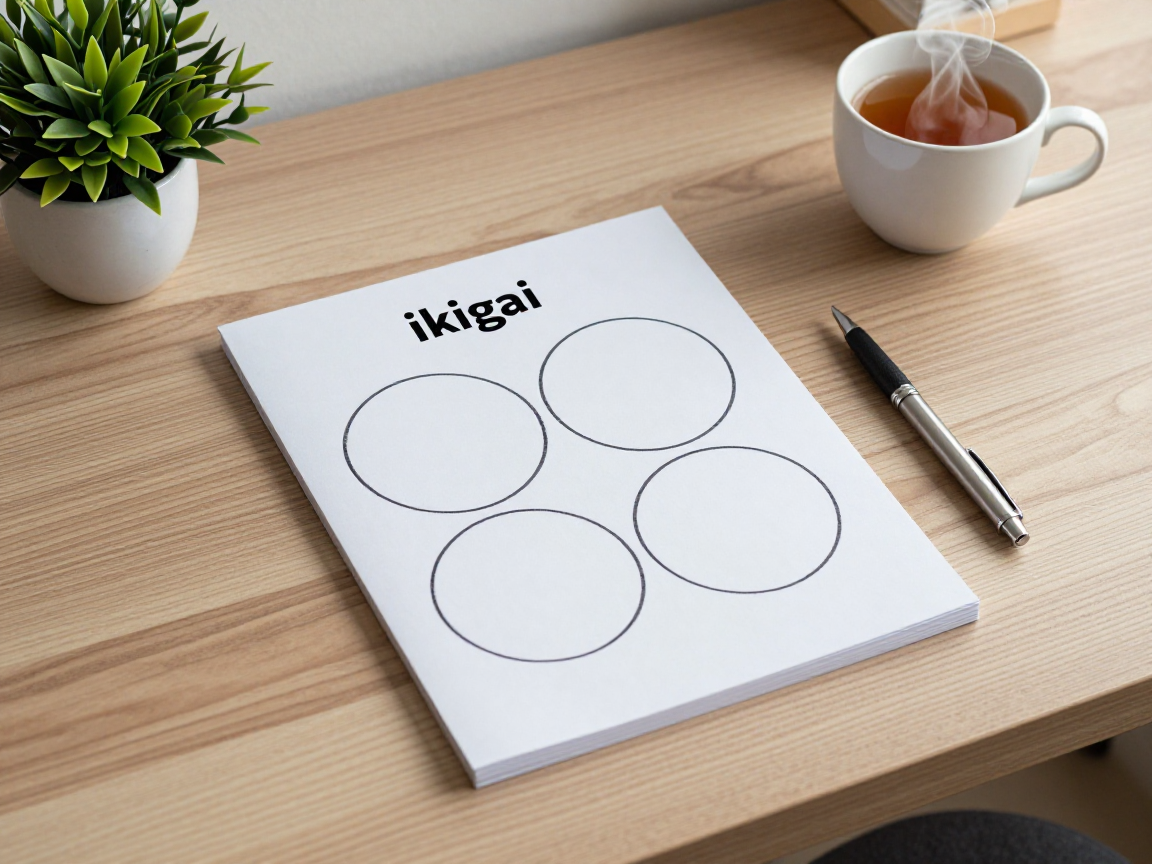
Many of us spend our lives moving between two distinct states: the exhaustion of a demanding career that pays well but lacks soul, or the quiet frustration of a hobby that brings joy but fails to sustain our lifestyle. This sense of being fragmented - of living a life split into boxes labeled "work" and "everything else" - is one of the primary drivers of modern burnout. When our skills do not match our values, or our passions do not serve a greater need, we begin to feel like we are simply going through the motions rather than living with intention.
The Japanese concept of Ikigai, often translated as "a reason for being" or "the reason you wake up in the morning", offers a profound framework for resolving this tension. While the philosophy originated in Okinawa, it has been adapted into a powerful visual tool that helps individuals identify the intersection of their talents, their values, and their professional reality. Using an ikigai worksheet is not just a creative exercise; it is a diagnostic process for your life. It allows you to step back from the noise of daily obligations and look objectively at where your energy is being spent and where it is being wasted.
Understanding the Four Circles of Purpose
To effectively use an ikigai worksheet, you must first understand the four fundamental pillars that support a balanced life. These circles represent the different facets of human existence that must be reconciled to find lasting satisfaction. Most people focus on only one or two of these areas, which leads to a life that feels incomplete. For instance, if you only focus on what you can be paid for, you may achieve financial success but feel empty inside. If you only focus on what you love, you may be happy but struggle to pay your bills.
The first circle is "What You Love". This is the realm of pure passion. It encompasses the activities that make you lose track of time, the topics you read about for fun, and the things that make you feel truly alive. The second circle is "What You Are Good At". This includes your natural talents, your learned skills, and the areas where you have a competitive advantage. The third circle is "What the World Needs". This shifts the focus outward toward service, community, and solving problems that exist in the environment around you. Finally, the fourth circle is "What You Can Be Paid For". This is the pragmatic reality of the marketplace and how you sustain your physical needs.
When you use an ikigai worksheet to map these out, you begin to see the overlaps. The intersection of what you love and what you are good at is your Passion. The intersection of what you love and what the world needs is your Mission. The intersection of what the world needs and what you can be paid for is your Vocation. The intersection of what you are good at and what you can be paid for is your Profession. Your true Ikigai lies at the very center, where all four of these components harmonize.
The Practical Ikigai Worksheet: A Step-by-Step Discovery Process
Finding your purpose is rarely an epiphany that happens overnight. Instead, it is a process of refinement. When you sit down with your ikigai worksheet, approach it with honesty and a lack of judgment. Do not write what you think you should say; write what is actually true for you in this moment. Use the following framework to populate your worksheet and find the common threads.
Step 1: Inventory Your Passions (What You Love)
In this section of the worksheet, look back at your childhood and your current free time. Ask yourself what you would do if money were no object and you had no social obligations.
- What activities make you feel energized rather than drained?
- What topics could you speak about for 30 minutes with zero preparation?
- When was the last time you were in a "flow state"?
Step 2: Audit Your Excellence (What You Are Good At)
This is often the hardest circle for people to fill out because we tend to be modest or overlook our own strengths. Think about both hard skills, like coding or accounting, and soft skills, like empathy or conflict resolution.
- What do people consistently ask you for help with?
- What tasks feel easy to you but seem difficult to others?
- In what areas have you received the most praise or professional recognition?
Step 3: Analyze the Market (What You Can Be Paid For)
This circle ground your dreams in reality. You must identify where your skills meet a demand that others are willing to compensate.
- What jobs or services are currently in high demand?
- What are you currently doing that generates income?
- What "side hustle" or alternative career paths have you considered?
Step 4: Identify the Need (What the World Needs)
Look at the world through a lens of service. This can be on a global scale or a very local, personal scale.
- What problems in your community frustrate you the most?
- What positive changes do you want to see in the next decade?
- What are the "pain points" of the people you interact with daily?
Bridging the Gaps in Your Current Life
Once your ikigai worksheet is filled with raw data, the next step is to look for the overlaps. You might find that you have a clear Passion (you love writing and you are good at it), but you haven't yet figured out how to turn it into a Profession or a Mission. Or perhaps you have a successful Profession (you are an expert accountant and get paid well), but it doesn't align with what you love or what you feel the world needs.
This gap analysis is where the real work begins. If you find yourself in a state where you have wealth but no meaning, your ikigai worksheet will show a void in the "What the World Needs" and "What You Love" sections. The goal is to slowly migrate your activities toward the center. This might mean keeping your day job (the Vocation and Profession circles) while volunteering or starting a creative project that fulfills the Mission and Passion circles. Eventually, you may find a way to merge them.
It is important to remember that Ikigai is not a static destination. It is a moving target. As you grow, your skills will evolve, and your passions might shift. Revisiting your ikigai worksheet every six months to a year is a healthy practice for staying aligned with your changing self. If you feel a creeping sense of dissatisfaction, it is usually a sign that one of the circles has been neglected or that the balance has shifted too far in one direction.
A 5-Day Framework for Refined Self-Discovery
If you are struggling to fill out the worksheet all at once, try this structured approach over the course of one week. Taking it slow allows your subconscious to bring ideas to the surface that you might miss in a single sitting.
- Day 1: The Internal Audit. Spend the entire day noticing when you feel "light" and when you feel "heavy". Note these moments on your worksheet under the "What You Love" section.
- Day 2: The External Mirror. Ask three trusted friends or colleagues what they think your greatest strength is. Add their answers to the "What You Are Good At" section.
- Day 3: The Global Scan. Read the news or look at your community with the specific goal of finding three problems you feel uniquely qualified to help solve. This populates "What the World Needs".
- Day 4: The Economic Reality. Research roles, industries, or freelance opportunities that involve the skills you listed on Day 2. Note these in "What You Can Be Paid For".
- Day 5: The Integration. Look at all four sections and circle any word or concept that appears in more than one list. These recurring themes are the keys to your Ikigai.
Why Your Ikigai Doesn't Have to Be Your Job
One common misconception when using an ikigai worksheet is the belief that your Ikigai must be your full - time career. While achieving this is a wonderful goal, it is not the only way to find meaning. For some, their Ikigai is found in their role as a parent, a hobbyist, or a community leader, while their job simply provides the financial stability to pursue those things.
The Western adaptation of Ikigai often places a heavy emphasis on "What You Can Be Paid For", but the original Japanese philosophy is more focused on the small, daily joys that make life worth living. It could be the way you make your morning coffee, the way you tend to your garden, or the way you support your friends. Your worksheet is a tool for alignment, but do not let the pressure of monetization ruin the joy of discovery.
If you find that your passion doesn't easily translate into a high-paying career, that doesn't mean it isn't part of your Ikigai. It simply means you need to find a balance where your professional life supports your personal mission. The worksheet serves as a map to ensure no part of your human experience is being left behind in the pursuit of a paycheck.
Moving from Paper to Practice
Once you have a clearer picture of your purpose through the ikigai worksheet, the final step is implementation. Start small. If your worksheet revealed that you love teaching and the world needs more literacy, but you currently work in data entry, you don't need to quit your job tomorrow. Instead, you might spend two hours a week tutoring.
This small action creates a "micro-ikigai" that can sustain you through the more mundane parts of your day. Over time, these small actions tend to grow. You may find yourself naturally gravitating toward teaching opportunities within your current company, or eventually transitioning into a new field altogether. The worksheet is the compass; you are the one who must take the steps. By continuously checking in with your four circles, you can ensure that you are moving toward a life that feels authentic, useful, and deeply satisfying.