The Border Between Worlds: How to Master the Hypnagogic State for Breakthrough Creativity
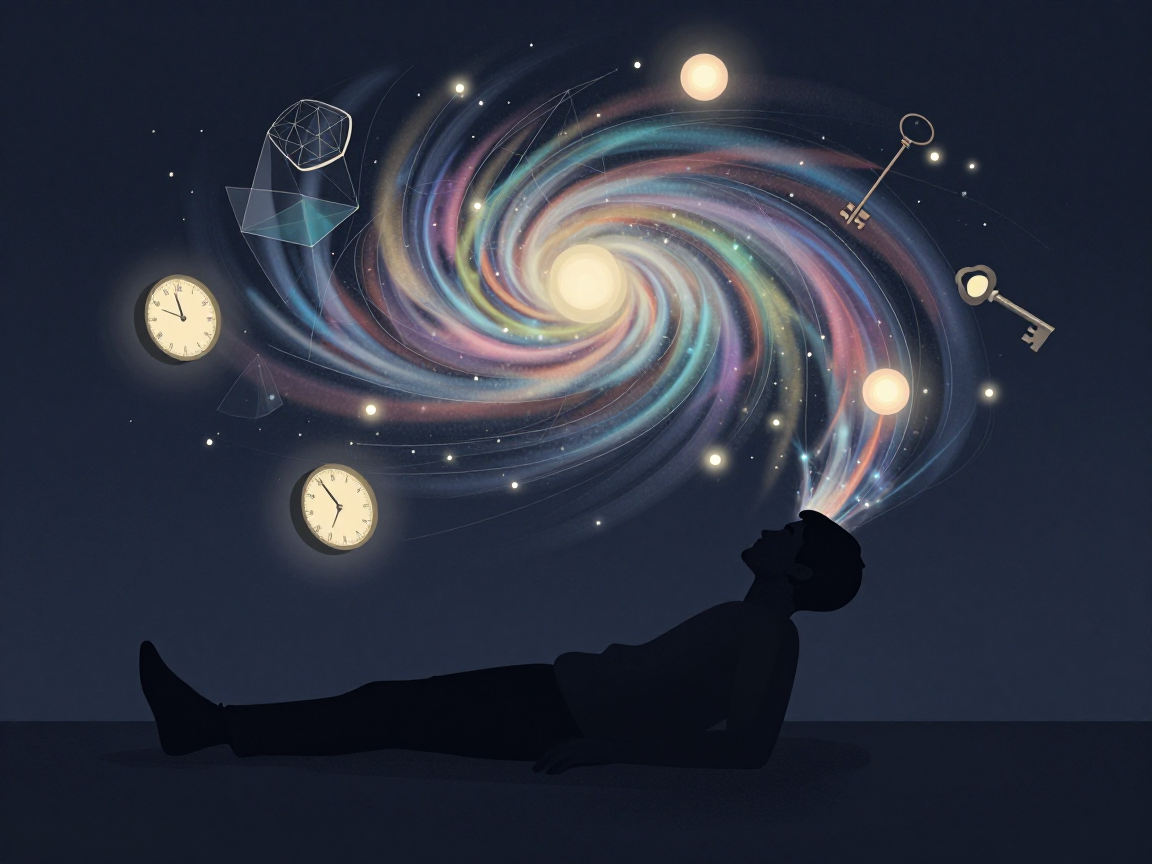
There is a fleeting, shadowy corridor through which we pass every night, yet we rarely acknowledge its existence. It is the threshold where the logic of the waking world begins to dissolve into the surrealist theater of dreams. This bridge is known scientifically as the hypnagogic state. It is the period of transition from wakefulness to sleep—a liminal space where the mind remains somewhat conscious while the body begins its descent into rest. For most, it is a brief moment of drifting off, but for those who learn to linger here, it is a frontier of immense creative and psychological potential.
During the hypnagogic state, the brain is in a unique neurobiological condition. It is not quite awake, yet it hasn't fully committed to the deeper stages of non-REM sleep. In this phase, our thoughts become non-linear, sensory hallucinations become vivid, and the rigid boundaries of our ego begin to soften. It is a time of incredible fluid intelligence, where the brain makes connections that the logical, waking mind would likely overlook. Understanding and navigating this state is like finding a back door into the subconscious mind, allowing us to harvest ideas that are normally buried beneath the noise of daily life.
Mapping the Border of Sleep: What Is the Hypnagogic State?
The hypnagogic state occurs during Stage 1 of the sleep cycle, often referred to as N1 sleep. From a neurological perspective, this is a time when the brain's electrical activity shifts from the fast beta waves of active alertness and the relaxed alpha waves of quiet contemplation into the slower theta waves. Theta waves are typically associated with deep meditation, creativity, and the doorway to the subconscious. While we usually think of sleep as a total loss of consciousness, the N1 stage is more of a fading out, where the "self" is still present but the "world" is receding.
Unlike the REM (Rapid Eye Movement) stage, where dreams are narrative and immersive, hypnagogia is characterized by fragmented imagery and sensations. You might see geometric patterns, flashes of light, or brief, disconnected scenes. Because the prefrontal cortex—the part of the brain responsible for logic, self-monitoring, and linear time—is beginning to power down, the mind becomes far more associative. This reduction in "executive control" allows for the "Aha!" moments that are so difficult to force during the day. This is why the hypnagogic state is often described as a state of hyper-suggestibility and raw, unfiltered ideation. It is a biological loophole that allows the conscious observer to peek at the subconscious machinery while it is still in motion.
The Kaleidoscope of the Mind: Common Hypnagogic Sensations
To effectively use the hypnagogic state, one must first recognize its symptoms. These experiences vary wildly from person to person, but they generally fall into several distinct categories. Recognizing these signals is the first step in learning to maintain awareness as you drift toward sleep. Many people experience these every night but dismiss them as simple "tiredness" rather than a distinct state of consciousness.
- Visual Hallucinations (Phosphenes): This is perhaps the most common trait. You may see speckles of light, swirling colors, or complex geometric patterns known as fractals. As the state deepens, these patterns may evolve into "actual" objects, such as faces, landscapes, or text that vanishes the moment you try to read it. These images are often incredibly vivid and colorful, far exceeding the clarity of a normal daydream.
- Auditory Hallucinations: It is common to hear your name being called, snippets of music, or fragments of conversation. Some people experience "exploding head syndrome"—a harmless but startling sensation of a loud bang or crash just as they fall asleep. These sounds feel as though they are coming from outside the body, even though they are entirely internal.
- The Tetris Effect: If you have spent your day performing a repetitive task, like playing a video game, gardening, or data entry, the hypnagogic state will often replay those specific movements or images. It is as if the brain is "sorting" the day's dominant visual inputs before storing them in memory.
- Physical Sensations: You might feel as though you are floating, spinning, or falling. This often culminates in a "hypnic jerk," a sudden muscle twitch that snaps you back to full wakefulness. Some report a feeling of heaviness or, conversely, a sense of total weightlessness.
- Weightlessness and Expansion: Many practitioners report a feeling of their body losing its boundaries, as if they are expanding to fill the room or shrinking into a single point of consciousness. This is a sign that the brain's internal map of the body (the proprioceptive system) is beginning to disconnect.
Historical Geniuses and the "Slumber with a Key"
History is filled with thinkers and artists who recognized that the hypnagogic state was a goldmine for innovation. They developed specific, often eccentric techniques to capture the ideas that surfaced during this transition before they were lost to the depths of heavy sleep. They viewed this state not as a byproduct of rest, but as a deliberate tool for creative problem-solving.
Thomas Edison, the prolific inventor, was famous for his use of hypnagogia. He would sit in a comfortable chair with a steel ball in each hand, placing metal pans on the floor directly beneath his arms. As he drifted into the hypnagogic state, his muscles would eventually relax, causing him to drop the balls. The resulting "CLANG!" against the pans would wake him up instantly, allowing him to scribble down whatever images or solutions were present in his mind at that exact moment. He believed this was the only way to catch the mind’s most original thoughts.
Similarly, the surrealist painter Salvador Dali used a technique he called "slumber with a key." He would hold a heavy metal key over a plate while napping. Dali believed that this "second of sleep" was the source of his most profound artistic visions. By catching himself at the very edge of the hypnagogic state, he was able to translate the bizarre, melted imagery of his subconscious directly onto the canvas. For these men, the state was a bridge that allowed them to bring back the "impossible" logic of the dream world into the tangible world of science and art.
The Threshold Protocol: A Step-by-Step Framework for Accessing Hypnagogia
If you want to experiment with the hypnagogic state yourself, the goal is to maintain a "thread of consciousness" while your body falls asleep. This requires a delicate balance; if you are too alert, you won't enter the state, but if you are too relaxed, you will simply fall asleep and forget the experience. Use the following framework to practice "staying on the line."
1. The Afternoon Window
Attempting this during your main night of sleep is difficult because your sleep drive is too high—your brain is desperate to get to deep sleep and REM. Instead, try during an afternoon nap or in the early morning after you have already had several hours of rest. This is when your "REM pressure" is high and your mind is more likely to stay hovering at the edge of wakefulness.
2. Physical Anchoring
You need a way to snap back before you fall into N2 or N3 sleep. You can use the Edison method, or a modern variation: lie flat on your back and lift one forearm so it is vertical, balancing it on your elbow. As you drift into the hypnagogic state, your muscle tone (atonia) will decrease, and your arm will start to fall. This physical movement acts as a "natural alarm" to pull your awareness back without fully waking you up.
3. Passive Observation (The Cinema Method)
As you close your eyes, do not "try" to see anything. Instead, adopt the role of a "disinterested observer." Watch the patterns behind your eyelids as if you are watching a movie you have already seen. If you try to focus too hard on a specific image, you will likely wake yourself up. If you let the images float by without judgment, they will become more complex and stable.
4. Engaging the Mental Inventory
Slowly scan through your day in reverse. This keeps the linguistic, logical mind occupied with a repetitive, boring task. This "distracts" the ego, allowing the visual and creative mind to start generating hypnagogic imagery around the edges of your thoughts. Once the imagery starts to become more vivid than the memories, you have successfully entered the state.
5. Capturing the Data
Keep a notebook or a voice recorder within arm's reach. The insights found in the hypnagogic state are notoriously "slippery." Because they occur during a transition in memory processing, they will disappear within seconds of full wakefulness if not recorded immediately. Even if the image seems nonsensical, write it down; the meaning often becomes clear later.
Using Hypnagogia as a Gateway to Lucid Dreaming
For those interested in lucid dreaming, the hypnagogic state is the primary "launching pad" for a technique known as WILD (Wake-Induced Lucid Dream). In a typical lucid dream, you realize you are dreaming while already inside the dream. In a WILD, you transition directly from wakefulness into the dream world without any lapse in consciousness. You are essentially watching the dream world build itself around you.
As you enter the hypnagogic state, the imagery will become increasingly stable. You might see a door, a landscape, or a room. Instead of just watching it, you can practice "reaching out" to touch the textures in the hallucination. By engaging your "dream senses" (touch, smell, or movement) during the hypnagogic state, you anchor your consciousness into the budding dream environment.
You may feel a sensation of rushing, buzzing, or loud vibrations; this is a sign that your brain is entering sleep paralysis to protect your body during sleep. If you stay calm and continue to observe the hypnagogic state without fear, the fragmented images will eventually "snap" into a fully realized, three-dimensional world that you can explore with full lucidity. It is one of the most profound experiences a human can have—stepping consciously from one reality into another.
Navigating Challenges: Fear and Sleep Paralysis
While the hypnagogic state is a source of wonder, it can also be a source of anxiety for the uninitiated. Because the mind is semi-conscious while the body is "switching off," it is possible to experience sleep paralysis. This is a condition where you are aware of your surroundings but unable to move. It is a natural part of the sleep cycle, but when experienced while conscious, it can trigger an instinctual fear response.
If this happens, it is important to remember that it is a natural physiological process—your brain is simply keeping you safe so you don't act out your dreams. The "fear" often associated with this state—sometimes manifesting as a feeling of a "presence" in the room—is simply the brain's amygdala (the fear center) overreacting to the fact that it is awake while the body is paralyzed. To navigate this, focus on small movements like wiggling a toe or changing your breathing pattern. Alternatively, you can choose to "lean in" to the sensation, using the paralysis as a springboard for an out-of-body experience or a lucid dream. The hypnagogic state is a mirror; if you approach it with curiosity, it reveals creativity, but if you approach it with fear, it reflects your anxieties.
Why We Need the Liminal Mind
We live in a culture that prizes "high-beta" productivity—the sharp, focused, and logical output of the waking day. We are taught that being "on" is the only way to solve problems. However, much of our true wisdom and creative fire resides in these "in-between" spaces. The hypnagogic state reminds us that the mind is not a binary switch that is either "on" or "off." It is a spectrum, a vast landscape with many territories left to explore.
By learning to inhabit the hypnagogic state, you gain access to a version of yourself that is less restricted by social conventions, logical fallacies, and self-doubt. In this state, the critic is asleep, but the creator is awake. Whether you are using it to solve a complex coding problem, find the next line of a poem, or simply explore the inner reaches of your own consciousness, this nightly transition is a gift. The next time you feel yourself drifting off, don't just let go. Stay a while. Watch the colors turn into worlds and see what the "liminal mind" has to tell you. You might find that the solution you've been seeking wasn't in the light of day, but in the shadows of the threshold.