Beyond Deep Breathing: How to Use Acupressure for Anxiety to Calm Your Nervous System in Minutes
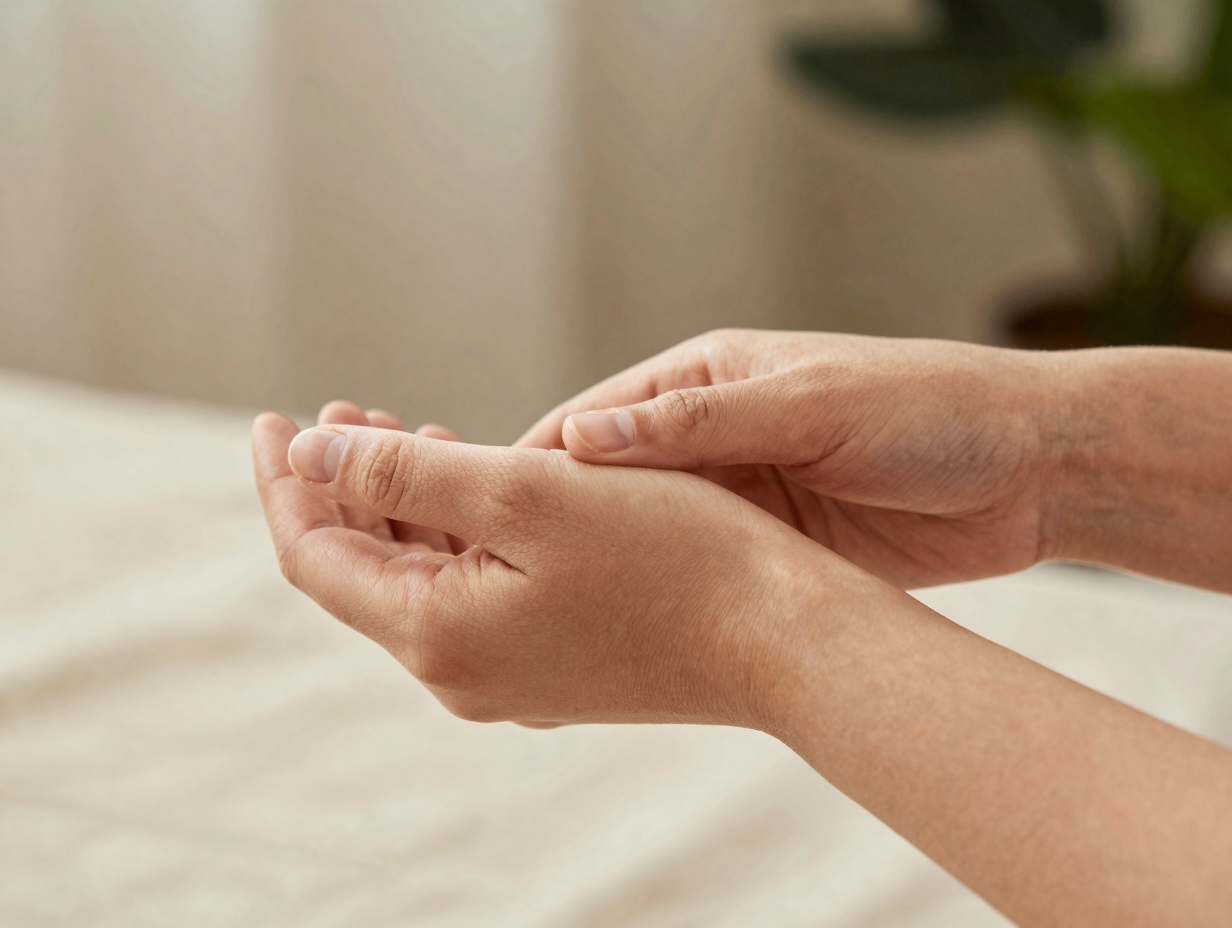
The experience of anxiety is rarely just a mental state. It lives in the body as a fluttering heart, a shallow breath, or a persistent knot in the pit of the stomach. When you are in the thick of a spiral, being told to ?just calm down? or ?stop worrying? often feels impossible because your brain has already shifted into survival mode. This is where the physical body becomes the most effective doorway to peace. By using acupressure for anxiety, you can bypass the logical mind and send a direct signal of safety to your nervous system, effectively flipping the switch from ?fight or flight? back to ?rest and digest?.
Acupressure is a traditional healing art that has been practiced for thousands of years, rooted in the same principles as acupuncture but requiring nothing more than your own hands. It involves applying firm pressure to specific points on the body to stimulate the flow of energy - or Qi - and trigger the release of tension. In the context of modern wellness, we now know that stimulating these points can influence the vagus nerve, lower cortisol levels, and encourage the production of endorphins. This makes acupressure for anxiety one of the most accessible and empowering tools for anyone looking to manage stress without external equipment or expensive therapy sessions.
The Science and Tradition of Somatic Relief
To understand why acupressure for anxiety is so effective, we have to look at how the body processes stress. When you encounter a perceived threat, your amygdala - the brain's alarm bell - triggers a cascade of hormones like adrenaline and cortisol. Your heart rate increases and your muscles tighten. This is an adaptive response for physical danger, but in our modern world, it often gets stuck in the ?on? position due to work stress, social pressure, or trauma.
Traditional Chinese Medicine (TCM) views this state as an imbalance or a blockage in the body's meridians. Meridians are essentially energetic pathways that connect our internal organs to the surface of our skin. When we use acupressure for anxiety, we are clearing these blockages. From a Western physiological perspective, we are stimulating mechanoreceptors under the skin that send signals to the brain to decrease the sympathetic nervous system's activity.
This ?bottom-up? approach is often more effective than ?top-down? approaches like cognitive behavioral therapy during a moment of acute panic. While talk therapy helps you understand the roots of your worry, acupressure addresses the physiological emergency happening in your chest and gut right now. It provides a tangible, physical anchor that pulls you out of a racing future and back into the present moment.
5 Essential Pressure Points for Immediate Calm
If you are new to this practice, the sheer number of points on the body can feel overwhelming. However, focusing on a few key areas can provide significant relief. Here are five of the most powerful points for applying acupressure for anxiety.
1. Yin Tang (Hall of Impression)
Located directly between your eyebrows, this point is often referred to as the ?Third Eye? point. It is perhaps the most famous point for calming a restless mind.
- How to find it: Place your finger at the bridge of your nose, exactly halfway between your eyebrows.
- How to use it: Use your thumb or index finger to apply gentle but firm pressure. You can hold it steadily or move your finger in tiny, slow circles. Close your eyes and breathe deeply for one to two minutes. This point is particularly helpful for insomnia and obsessive thinking.
2. Pericardium 6 (Inner Gate)
Also known as PC6 or Nei Guan, this point is excellent for the physical symptoms of anxiety, such as a racing heart, chest tightness, or nausea.
- How to find it: Turn your hand over so your palm is facing up. Place three fingers across your wrist, starting from the crease where your hand meets your arm. The point is located in the center of your arm, just below your three fingers, between the two large tendons.
- How to use it: Apply firm pressure with your thumb. You may feel a slight ache or tingling; this is a sign you have found the right spot. Hold for one minute on each wrist.
3. Heart 7 (Spirit Gate)
In TCM, the Heart is considered the ?Emperor? of the body and the seat of the mind. The Spirit Gate, or Shen Men, is used to soothe the spirit when it feels frayed or frightened.
- How to find it: Locate the crease in your inner wrist on the pinky-finger side. There is a small hollow space right at the base of the pisiform bone (the small round bone at the edge of the wrist).
- How to use it: Use your thumb to press into this hollow. This point is a favorite for those who feel ?jittery? or ungrounded. Apply pressure for one minute while focusing on softening your shoulders.
4. Governing Vessel 20 (Hundred Convergences)
Known as Bai Hui, this point is located at the very top of the head. It is used to clear the senses and settle the upward-rushing energy that often accompanies panic attacks.
- How to find it: Imagine a line running from the tips of your ears to the center of your scalp. Where those lines meet at the peak of your head is the point.
- How to use it: Use several fingers to apply light, downward pressure or gentle tapping. This can help ?pull? your energy back down when you feel like your head is spinning.
5. Large Intestine 4 (Union Valley)
While often used for headaches, LI4 is a powerful point for releasing general tension and ?letting go? of emotional weight.
- How to find it: Look at the fleshy webbing between your thumb and index finger. Squeeze them together; the highest point of the muscle bulge is the location.
- How to use it: Deeply pinch this webbing with the thumb and forefinger of your opposite hand. Warning: This point should be avoided if you are pregnant, as it can induce labor.
A 10-Minute Daily Protocol for Emotional Regulation
Consistency is the key to training your nervous system to remain resilient. While you can use acupressure for anxiety as an emergency measure, practicing it daily builds a ?reservoir? of calm. Follow this simple framework to integrate these points into your morning or evening routine.
- Set the Environment: Find a quiet place to sit or lie down. You do not need music or candles, but a few minutes of uninterrupted time is essential.
- Check-In: Close your eyes and scan your body. Where are you holding tension? Is it in your jaw, your chest, or your stomach? Rate your anxiety on a scale of 1 to 10.
- The Sequence:
- Start with Yin Tang (between eyebrows) for 2 minutes to quiet the mind.
- Move to GV20 (top of head) for 1 minute to ground your energy.
- Apply pressure to PC6 (inner wrist) on both arms for 1 minute each to open the chest and regulate the heart.
- Finish with HT7 (pinky side of wrist) for 1 minute on each side to settle the spirit.
- Incorporate Breath: As you hold each point, breathe in for a count of four, hold for two, and exhale for a count of six. The long exhale further stimulates the vagus nerve.
- Re-evaluate: After the sequence, scan your body again. Notice if the ?number? of your anxiety has dropped. Even a small shift is a success.
Why Body-First Approaches Work When Thinking Fails
Many people feel frustrated because they cannot ?rationalize? their way out of anxiety. They know they are safe, they know the plane isn't going to crash, or they know the work presentation will be fine - yet their body is screaming otherwise. This is because the emotional centers of the brain, like the limbic system, process information much faster than the prefrontal cortex, which is responsible for logic.
When you use acupressure for anxiety, you are communicating in the body's native language. You are providing a physical sensation that competes with the internal sensation of fear. This creates a ?circuit break?. By giving your hands something to do and your brain a physical sensation to focus on, you regain a sense of agency. You are no longer a passive victim of an adrenaline surge; you are an active participant in your own regulation.
Furthermore, acupressure encourages a state of mindfulness. To find the points, you must become intimately acquainted with your own anatomy. This shifts your relationship with your body from one of ?brokenness? or ?betrayal? to one of partnership. You begin to see your body as a tool for healing rather than just a source of discomfort.
Common Mistakes and How to Maximize Results
To get the most out of your practice, keep these practical tips in mind:
- Not enough pressure: The pressure should be firm enough that it feels slightly tender or heavy, but never sharp or painful. If you feel nothing at all, you may need to press a bit deeper.
- Giving up too soon: Your nervous system is like a large ship; it takes a moment to change course. Do not expect an immediate 180-degree turn in the first ten seconds. Commit to at least sixty seconds per point.
- Holding your breath: It is common to hold your breath when you are concentrating or in pain. Ensure your breath remains fluid. If you stop breathing, you are inadvertently signaling more stress to the brain.
- Using it only as a last resort: If you only use acupressure for anxiety when you are at a level 10 panic, it will be harder to find the points and stay focused. Practice when you are at a level 3 or 4 so that the movements become muscle memory for when you truly need them.
By incorporating these points into your life, you build a portable toolkit for emotional freedom. Whether you are in a crowded subway, a tense boardroom, or lying awake at 3:00 AM, you have the ability to influence your internal state. Acupressure for anxiety reminds us that while we cannot always control the world around us, we have a profound and ancient map right at our fingertips to help us navigate our way back to calm.