The Art of Being Alone: Why Understanding Loneliness vs Solitude is the Ultimate Modern Skill
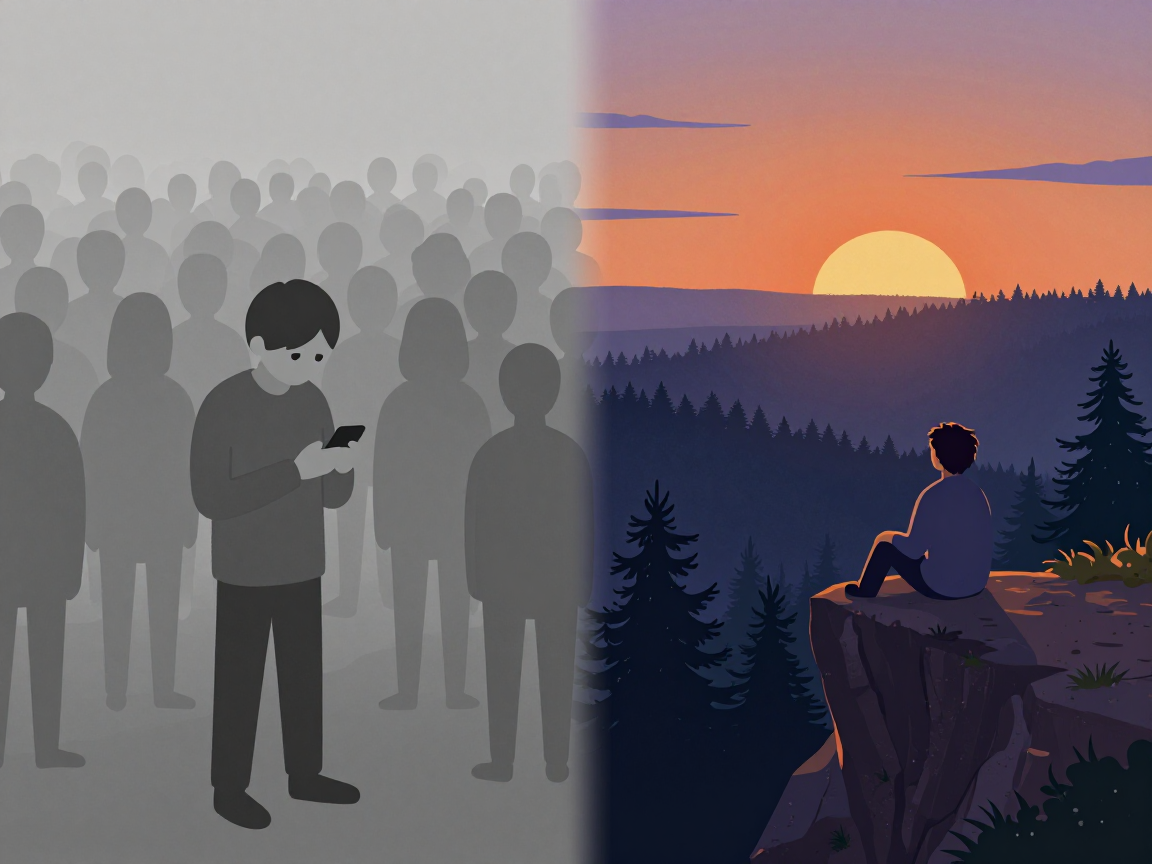
In an era defined by hyper-connectivity, we find ourselves in the midst of a strange psychological paradox. We are tethered to the world by glowing screens and infinite notifications, yet the global rates of reported isolation are climbing. We can communicate with someone on the other side of the planet in an instant, yet many of us go through our days feeling fundamentally unseen. To navigate this landscape without losing our mental well-being, we must master a crucial distinction: the difference between loneliness vs solitude.
While we often use these terms interchangeably, they describe two entirely different internal landscapes. One is a state of deficiency, a gnawing hunger for connection that isn't being met. The other is a state of abundance, a chosen presence with oneself that fosters creativity, resilience, and peace. Understanding how to move from the former to the latter is not just a self-help exercise; it is a necessary survival skill for the 21st century.
The Fundamental Distinction: A State of Lack vs. a State of Fullness
At its core, the debate of loneliness vs solitude comes down to agency and perception. Loneliness is a passive state. It is something that happens to us when we feel a gap between our desired social contact and our actual social reality. It is a feeling of being 'cast out,' characterized by a sense of isolation and a longing for something—or someone—to fill the void. In this state, being alone feels like a punishment.
Solitude, by contrast, is active and intentional. It is the practice of being alone without being lonely. When we are in solitude, we are not waiting for someone else to arrive to make the moment valid. We are, instead, keeping ourselves company. As the theologian Paul Tillich famously noted, 'Language... has created the word loneliness to express the pain of being alone. And it has created the word solitude to express the glory of being alone.'
When you are lonely, the silence feels heavy and oppressive, like a weight. When you are in solitude, the silence feels expansive, like room to breathe. One is a hunger; the other is a feast. The goal of mental health is not to eliminate being alone, but to transform the time we spend by ourselves into a restorative experience rather than a draining one.
The Biological Reality of the Lonely Brain
To understand why loneliness vs solitude feels so different, we have to look at what is happening inside our bodies. Evolutionarily, loneliness was a survival mechanism. For our ancestors, being separated from the tribe was a death sentence. To prevent this, the brain developed a 'social pain' signal—loneliness—to drive us back toward the safety of the group.
When we experience chronic loneliness, our nervous system enters a state of 'hyper-vigilance.' The brain begins to perceive the world as a more threatening place. Cortisol levels rise, sleep quality drops, and the immune system becomes less effective. Research has shown that the health impact of chronic loneliness is comparable to smoking 15 cigarettes a day or being obese. It is a physiological alarm bell telling us that our 'social body' is undernourished.
Solitude, however, allows the brain to exit this high-stress state. When we engage in intentional solitude, we activate the 'Default Mode Network' (DMN). This is the part of the brain responsible for self-reflection, processing memories, and imagining the future. While loneliness keeps us stuck in a reactive, 'fight or flight' posture, solitude allows us to move into a 'reflective' posture. This is where we integrate our experiences and make sense of our lives.
The Digital Trap: Why We Are Rarely Truly Alone
One of the biggest obstacles to mastering loneliness vs solitude today is the 'social tether' of the smartphone. We have reached a point where we are rarely physically with others, but also rarely truly alone. We spend our 'alone time' scrolling through the highlight reels of thousands of other people.
This creates a dangerous middle ground. It provides enough social stimulation to keep us from seeking real-world intimacy, but it isn't high-quality enough to satisfy our biological need for connection. Even worse, it prevents us from entering true solitude. Because we are constantly reacting to the opinions, photos, and news of others, our minds never have the chance to settle into their own original thoughts. We end up in a state of 'connected isolation'—lonely because we lack intimacy, yet unable to find solitude because we lack silence.
To move from loneliness to solitude, we have to be willing to put down the digital mirror and face the initial discomfort of the quiet. The 'itch' to check your phone is often just the brain’s resistance to being alone with itself. If you can sit through that discomfort, something beautiful usually happens on the other side: you begin to hear your own voice again.
A 4-Step Framework for Transforming Loneliness into Solitude
Transitioning from the pain of loneliness vs solitude’s restorative power requires a shift in how we relate to ourselves. If you find yourself feeling drained by your own company, use this framework to reclaim that time.
1. Externalize and Validate the Feeling
Loneliness thrives on shame. We often feel that being lonely is a sign that we are 'unlikable' or 'unwanted.' The first step is to strip away that narrative. Recognize that loneliness is simply a biological signal, like hunger or thirst. When you feel the ache, say to yourself: 'I am experiencing a signal for connection.' By naming it as an external signal rather than a personal failure, you reduce its emotional grip, making it easier to manage.
2. Practice 'Intentional Disconnection'
You cannot build the muscle of solitude if you are constantly being interrupted by the outside world. Start small. Set a 'Solitude Window' of 15 to 30 minutes a day where your phone is in a different room. During this time, the goal is not to be productive, but to be present. You are practicing the art of 'just being.' This break from the attention economy is the foundational requirement for turning isolation into a choice.
3. Engaged Observation (The Solo Date)
Solitude is often easier when it is paired with an activity that doesn't involve a screen. This is the 'Solo Date' concept. Go to a museum, sit in a park, or eat at a restaurant alone without a book or a phone. Focus on observing the world around you. When you shift your focus from 'I am alone and people are looking at me' to 'I am an observer of this beautiful, complex world,' you transition from the self-consciousness of loneliness to the curiosity of solitude.
4. Create an Internal Dialogue
Loneliness is characterized by a feeling of being 'empty.' Solitude is characterized by being 'full' of oneself. Start a journaling practice where you talk to yourself about your day, your fears, and your goals. When you develop a strong internal dialogue, you become your own best companion. You realize that even when no one else is around, you are still in the presence of someone worth knowing.
The Solitude Audit: A Checklist for Growth
How do you know if you are successfully moving toward healthy solitude or if you are sliding deeper into loneliness? Use this quick checklist to audit your time alone:
- The Choice Test: Did I choose this time for myself, or was it forced upon me by circumstance? (Solitude is chosen; loneliness is imposed).
- The Energy Test: After my time alone, do I feel more grounded, or do I feel more frantic and desperate for a distraction?
- The Comparison Test: Am I spending my 'alone' time comparing my life to others on social media, or am I engaging with my own thoughts?
- The Creative Test: Have I had any new ideas or realizations lately? (Solitude is the greenhouse of creativity; loneliness is its desert).
- The Physical Test: Is my body relaxed, or am I holding tension in my jaw and shoulders, scanning for a 'threat' in the silence?
Why We Need Solitude to Be Better Together
Perhaps the most surprising truth about loneliness vs solitude is that mastering the latter actually makes us better at the former. When we are afraid to be alone, we often cling to people out of desperation. We use others as a 'buffer' against our own inner void. This leads to shallow, needy relationships where we aren't truly seeing the other person—we are just using them to avoid ourselves.
When we have cultivated a rich inner life through solitude, we enter relationships from a place of wholeness. We don't 'need' the other person to survive; we 'want' them to share in the life we’ve already built. This makes our connections deeper, more authentic, and less fraught with anxiety.
Solitude is the 'recharging station' for our social batteries. By taking the time to process our emotions and clarify our values in private, we bring a more stable, present version of ourselves to our public lives. You cannot truly be 'with' someone else until you have learned how to be 'with' yourself.
Conclusion: Making Peace with the Silence
The journey of loneliness vs solitude is one of the most important transitions a person can make. It is the move from being a victim of your circumstances to being the master of your internal world.
Next time you find yourself alone and that familiar ache begins to rise, try to view it as an invitation. Don't reach for the phone immediately. Don't turn on the TV just to fill the air. Instead, take a deep breath and step into the quiet. Ask yourself what you’re feeling. Notice the world around you. Recognize that in the silence, you aren't actually losing anything—you are gaining the one thing that modern life constantly tries to steal: yourself.