The First Number Trap: Why Your Brain Latches onto High Prices and How to Master Anchoring Bias
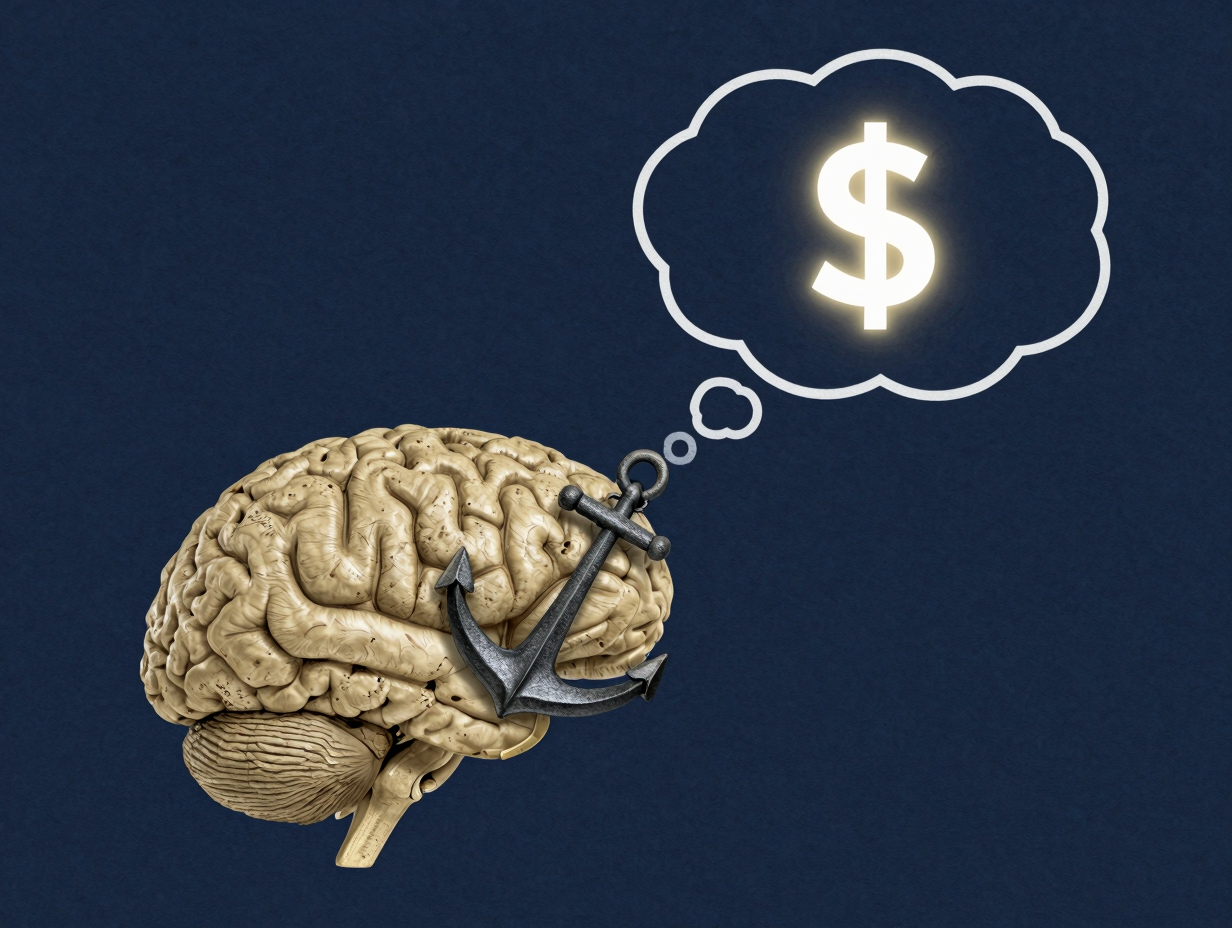
Imagine you are walking through a high - end department store and you spot a leather jacket. The tag says $1,200. You scoff at the price, thinking it is far too expensive for your budget. But right next to it is another jacket, marked down from $1,200 to $600. Suddenly, $600 feels like a steal. You find yourself considering the purchase, even if you walked into the store with a strict $300 limit. This is the subtle, pervasive power of anchoring bias at work. It is a mental shortcut that tricks us into over - relying on the first piece of information we receive - the anchor - when making subsequent judgments.
Our brains are wired for efficiency, not necessarily for accuracy. In a world saturated with data, we look for reference points to help us make sense of value and scale. Once an anchor is set, all other possibilities are judged in relation to that initial point rather than on their own objective merit. This cognitive quirk does more than just influence our shopping habits; it shapes our salary negotiations, our legal systems, and even our personal relationships. To truly master our decision - making processes, we must understand why anchoring bias happens and how to loosen its grip on our logic.
The Science of the First Impression
At its core, anchoring bias is a byproduct of how we process uncertainty. When we do not know the true value of something, we grab onto whatever number or fact is available to us. This phenomenon was famously documented by psychologists Amos Tversky and Daniel Kahneman in the 1970s. In one of their most famous experiments, they asked participants to spin a wheel of fortune that was rigged to land on either 10 or 65. After the wheel stopped, participants were asked to estimate the percentage of African nations in the United Nations.
Logic suggests that a random number on a wheel should have zero impact on a geographical or political estimate. However, the results were startling. Those who saw the number 10 on the wheel gave an average estimate of 25 percent, while those who saw 65 gave an average estimate of 45 percent. The participants had been subconsciously "anchored" by a completely irrelevant number. Even when we know an anchor is random, our brain finds it difficult to stray too far from that starting point. This is known as the "adjustment" phase, where we try to move away from the anchor but usually end up stopping at the first plausible - sounding value.
Why We Fail to Adjust Properly
The reason anchoring bias is so difficult to overcome is that it operates in the background of our consciousness. We don't feel like we are being influenced; we feel like we are being rational. Psychologists point to two main reasons for this failure to adjust. First, there is the "insufficient adjustment" theory, which suggests that we start at the anchor and move away until we reach a range of values that seem reasonable. Because moving away takes mental effort, we tend to stop at the very edge of that range, which is still heavily influenced by the starting point.
Second, there is the "selective accessibility" theory. This suggests that when we are presented with an anchor, our brain immediately begins searching for reasons why that anchor might be correct. If someone tells you a house is worth $1 million, your brain automatically starts looking for features that justify a high price - like the crown molding or the neighborhood - rather than looking for flaws that might lower the value. You become a victim of your own selective memory, reinforcing the anchor with every thought.
Common Areas Where Anchoring Bias Rules
Understanding the mechanics of anchoring bias is the first step, but recognizing it in the wild is where the real work begins. It manifests in almost every professional and personal interaction where value is being assessed.
1. Salary and Business Negotiations
In a job interview, the first person to name a number usually sets the anchor. If an employer asks for your salary expectations and you say $80,000, the entire conversation will revolve around that figure. Even if the company had a budget of $100,000, they are now focused on the $80,000 mark. Conversely, if an employer starts with a low offer, it becomes incredibly difficult for the candidate to pull the conversation toward a much higher bracket because the anchor has already been dropped.
2. Retail and Marketing
This is perhaps the most obvious use of anchoring bias. Retailers use "suggested retail prices" or "original prices" specifically to make the sale price look better. When you see a sign that says "Limit 12 per customer" , you are more likely to buy more than if there were no limit at all. The number 12 acts as an anchor, making the purchase of four or five cans of soup seem modest, whereas you might have only bought one otherwise.
3. Legal and Medical Settings
Anchoring can have life - altering consequences in courtrooms and hospitals. In legal cases, the initial demand for damages can anchor a jury's eventual award. Even if the demand is seen as excessive, the final settlement often trends higher than if a lower initial figure had been requested. In medicine, a doctor might be anchored by a previous physician's diagnosis. If the first doctor suggests a specific condition, the second doctor may spend more time looking for evidence to support that diagnosis rather than evaluating the patient with a fresh perspective.
A 5-Step Framework to De-Anchor Your Decisions
You cannot eliminate anchoring bias entirely - it is a fundamental part of human cognition - but you can mitigate its effects. Use this "De-Anchoring Protocol" whenever you are faced with a significant decision or a high - stakes negotiation.
Step 1: Recognize the Anchor
Awareness is your primary defense. When you hear a number or a definitive statement, tell yourself: "This is an anchor" . Labeling it as such shifts your thinking from intuitive (System 1) to analytical (System 2). Once you identify the anchor, you can consciously question its validity.
Step 2: Conduct Independent Research
Never walk into a negotiation or a major purchase without your own data. If you are buying a car, know the market value before you step onto the lot. If you have your own data - driven anchor before the other party speaks, you are less likely to be swayed by their starting point. Your internal anchor acts as a shield against external influence.
Step 3: Create a "Reasoning Counter-Anchor"
If someone drops an anchor on you, do not just try to move away from it. Instead, immediately think of reasons why that anchor is wrong. If a salesperson says a product is worth $500, list three reasons why it might be worth only $200. By actively generating counter - arguments, you break the "selective accessibility" cycle where your brain tries to justify the anchor.
Step 4: The "Walk Away" Threshold
Determine your limits before the interaction begins. In negotiations, this is often called your BATNA (Best Alternative to a Negotiated Agreement). By knowing exactly when you will walk away, you prevent the anchor from dragging you into a deal that doesn't serve your interests. If the anchor is outside your pre - determined range, do not even engage with it.
Step 5: Delay the Decision
Anchoring bias thrives on momentum and pressure. The more quickly you have to react to an anchor, the more likely you are to stay close to it. If possible, step away from the situation. Go for a walk, sleep on it, or consult a third party who hasn't heard the anchor. Time allows the emotional pull of the initial information to fade, giving your rational mind a chance to catch up.
The Power of Setting the Anchor
While most of our focus is on avoiding the trap of anchoring bias, it is also a tool you can use ethically to achieve better outcomes. In many professional scenarios, being the one to drop the anchor first can give you a significant advantage. If you have done your research and you know the fair market value of your services, being the first to state a price can frame the entire negotiation in your favor.
However, this requires precision. If you set an anchor that is too extreme - like asking for $200,000 for a job that typically pays $70,000 - you risk damaging your credibility and causing the other party to walk away entirely. The most effective anchors are those that are ambitious but defensible with data. When you provide a reason for your anchor, you encourage the other person's brain to look for evidence that supports your number, turning the bias into your ally.
Red Flags: Signs You Are Being Anchored
- The "Sale" Focus: You are more interested in the amount you are "saving" than the actual price you are paying.
- Relativity Over Reality: You find yourself saying, "Well, it's cheaper than the other one" , rather than, "This is a fair price for this item" .
- The Middle Option Trap: You are presented with three options (e.g., Good, Better, Best) and you choose the middle one simply because the expensive one makes it look reasonable.
- Immediate Consensus: You find yourself agreeing with the first suggestion made in a meeting without considering alternatives.
- The Default Effect: You stick with a default setting or a "standard" contract clause because it was the first thing presented to you.
Reclaiming Your Mental Autonomy
The human mind is a marvelous instrument, but it is prone to shortcuts that don't always lead us to the best destination. Anchoring bias is one of the most stubborn of these shortcuts because it feels like common sense. It feels natural to compare a new piece of information to the one that came before it. But in a world where marketers, negotiators, and even our own subconscious are constantly trying to set the terms of our reality, we must be vigilant.
By slowing down our decision - making process and demanding objective evidence for the values we accept, we can begin to see past the anchors. We can learn to view a price, a salary, or a diagnosis not as a fixed point in space, but as a single data point in a much larger landscape. The goal is not to live a life free of biases - that is an impossible task - but to build a toolkit that allows us to recognize when we are being pulled off course and to have the courage to set our own direction.